Which Blood? Which Soil?

On Friday night as the White Supremacists marched in Charlottesville, VA, they chanted “Blood and Soil”. Yes, “Blood and Soil”.
The Nazis, who popularized the phrase, said “Blut und Boden”.

The phrase originates from the 19th century Germany. Blood and Soil refers to a school of thought that looks at ethnicity based on two factors, descent blood and territory. It celebrates the relationship of a people to the land they occupy and cultivate, and it places a high value on the virtues of rural living.
Richard Walther Darré rejuvenated the phrase during the time of Nazi Germany through his 1930 book “Neuadel aus Blut und Boden “(A New Nobility Based On Blood And Soil). The gist of it was that certain people, by virtue of their blood affinity—that is, their racial ancestry—belonged to the soil of Germany, the Fatherland. It further espoused the idea that real Aryans lived and worked on rural areas of Germany as farmers. That in working with the soil did one really show that his blood was that of a German.
Well, don’t forget that Germany even then was a heavily industrialized nation so I guess all the factory worker were not real Germans.
However, there was a ruthless cunning to all that. The cities were inhabited by factory workers who were most probably in a Union or were communists. The cities also contained the left-leaning and liberal Germans and even more ominously, the arch-enemy of the Nazis, the Jews.
It’s 2017, and White Supremacists are chanting “Blood and Soil”….”Blut und Boden”.
This begs the questions, “Which blood and which soil?”

You see, the originals put out by this soil here were all exterminated like vermin many hundreds of years ago. Those men who marched are the product this soil put out subsequently.
However, what this soil has since put out is not a pure white race but a mix of races – white, black, red, yellow, brown… a real potpourri.
One can split hairs over whether all these different races belong in this pot or not but they are here, some forcibly. They laid their seed, filled the land and now we have this kaleidoscope of people.
Then is the issue of blood. Copious amounts have drenched this soil. The blood of millions of native Americans murdered, thousands of African slaves killed and the innumerable men who died during the civil war. Do not the descendants of all these people, whose blood built this land belong here?
If not then those who belong must have a special trait. Those who belong are the real “Americans”.
Yet, who is this real American? Can we know by the blood that runs through them? That will be difficult because blood always runs red. Can the soil tell us? I doubt it because how can the soil really tell? It’s been drenched with all kinds of blood and swallowed up all manner of bodies so much so, that it also keeps asking, “Who is the real American?’
That leaves us just one more option – the color of the skin.
Aha!, now we are getting somewhere.
Blood and Soil.
If your skin is not white, then your blood does not come from the stock of people who are seen fit to occupy this soil. Then you have no mystical attachment to this soil. You do not belong. You do not belong.
Wouldn’t it just be easier to say that instead of taking this “Blood-Soil” detour?
Of course, silly me, they do say that…..in many ways… and theirs actions express it too…with many sides.
Blood and Soil!
A small reminder that in spite of the illusion of inclusion, some skin colors are most unwelcome on this soil.
Not their blood! Not on this soil!
Pain Pays the Income of Each Precious Thing

Of all the rotations I had to do as a resident, my least favorite was Pain Management. I never enjoyed that specialty. Pain being a rather subjective sensation, it is almost impossible to measure. What a patient says must be taken at face value unless there are circumstances and clinical signs that contradict his or her story. No matter how much empathy one has, there is always the feeling that some patients are not being truthful and that pain was being used as a bargaining chip. A chip to obtain narcotics and not work. Don’t get me wrong – there were patients who were truly in chronic pain but more often than not, those patients found a way to lead a life that was not totally ruled by their suffering.
It was during that rotation that I learnt the term, “Pain pays” and came to realize how true it is.
For the patient, pain brings attention, an excuse from working, doting on by a loved one and pain medications that often lend a high.
For the physician, it is cash from perform pain-alleviating procedures on these patients and the lure of a “pill mill”.
For the drug companies, selling all those pain pills spells profits.

Pain pays!
Shakespeare uses the term in his 1594 narrative poem, “The Rape of Lucrece”.
The poem tells the story of Tarquin, the son Lucius Tarquinius, King of Rome. Tarquin was a soldier in his father’s army besieging Ardea. One night, all the men bragged about how chaste and virtuous their wives were. To prove their claims, they all secretly retuned to Rome to see if each other’s wife was as described. The only wife who proved chaste, virtuous and was incredibly beautiful was Lucerne, wife of the soldier, Collatinus, a friend of Tarquinius’. Her chastity and virtue sparked something in Tarquinius. When they all retuned to Ardea, he stole back to Rome and went to Collatinus’s home.
Lucrece, seeing her husband friend and the king’s son, welcomed him and allowed him to spend the night. In the middle of the night, he entered her room, raped her and fled.
Prior to the act, he debated with himself whether he should commit the dastardly act. As he comes to the door of her bedroom he says to himself:

“Pain pays the income of each precious thing;
Huge rocks, high winds, strong pirates, shelves and sands,
The merchant fears, ere rich at home he lands.”

Lucrece summoned her father and husband the next day back to their home in Rome. She asked them to avenge what had happened to her, told them the story and then stabbed herself to death. Her husband and father carried her body to the public square and told the people of Rome what had happened. The Tarquinius family was chased out of Rome, ending the monarchy.

Did pain really pay?
For a while, Tarquinius may have enjoyed the bitter fruits of his act but his win led to death and misery for all involved.

Before the 1990s, doctors used opioids rather sparingly. One can say that pain was under-treated. Narcotics were mainly given to cancer patients. Then in 1980, Hershel Jick published a study claiming that the use of narcotics in 11,882 in-patients led to only 4 cases of addiction. Six years later, Portenoy published his study looking at the use of narcotics in non-cancer patients. He claimed there were no adverse effects. He studied 38 patients on which he based his claims!
Even though both studies were highly flawed, they dramatically changed medical thinking and then practice. Portenoy formed the American Pain Society and preached that the risk for opioid addiction was less than 1% – a number he would later confess that he grabbed out of thin air!
The society came up with “Pain as a 5th vital sign” slogan and it caught on.
Into this fray was dropped the drug Oxtcontin by Purdue Pharma in 1996. With aggressive marketing, they promoted this new drug.
The Joint Commission got behind pain the 5th vital sign. By 2004, doctors who under treated pain faced sanctions. Opioids were being prescribed to all, even outpatients. Later Endo Pharma and Johnson & Johnson would join the opioid party with their own portfolio of synthetic opioids.
Purdue Pharma claimed that oxycontin was a slow-release formulation and would never lead to addiction. Well, we know better now. They had to pay $635 million in fines in 2007 for misbranding and reformulate the dug but by then it was too late.
By 2012, sales of opioids were more than $9 billion a year and in 2013, opioid overdose surpassed car accidents as the number one cause of accidental death.
These patients are now not just sticking to prescribed narcotics but using heroin, cocaine as well as illegally made fentanyl and karfentanyl of unknown potency!

Like Tarquinius, pain did pay the income of each precious thing. The drug companies got rich. Doctors ran “pill mills” where they prescribes opioids like candy… and got rich. Whatever misgivings these players may have had was only like “ the merchant who fears, ere rich at home he lands”.
Like Tarquinius, doctors and the pharma companies took from these patients something really valuable. Almost as valuable as what was taken from Lucrece. They took away their will to not fall prey to opioid addiction. They took away their independence and sense of worth. They made them dependent. All those years of easy narcotics made all these patients highly susceptible to addiction to heroin and cocaine.
Lucrece killed herself shortly after her defilement. These patients are however dying slowly albeit in large numbers. However the misery their fading lives cause is as profound as that which Lucreces’ father and husband felt.

How his all this going to end?
Are the drug companies and doctors going to get banned from our cities?
Already, states like Ohio are suing the drug companies to force them to finance the care of all these addicts. Will doctors be held liable too?
Whatever happens, I hope we all learn that pain is not a means to amass wealth but rather a sign that the sufferer needs help.

The Scavenger

In 1993, Sudan was in the throes of a second civil war and famine racked the south. The UN and other relief organizations had set up camps and feeding centers to try and alleviate the plight of the South Sudanese.

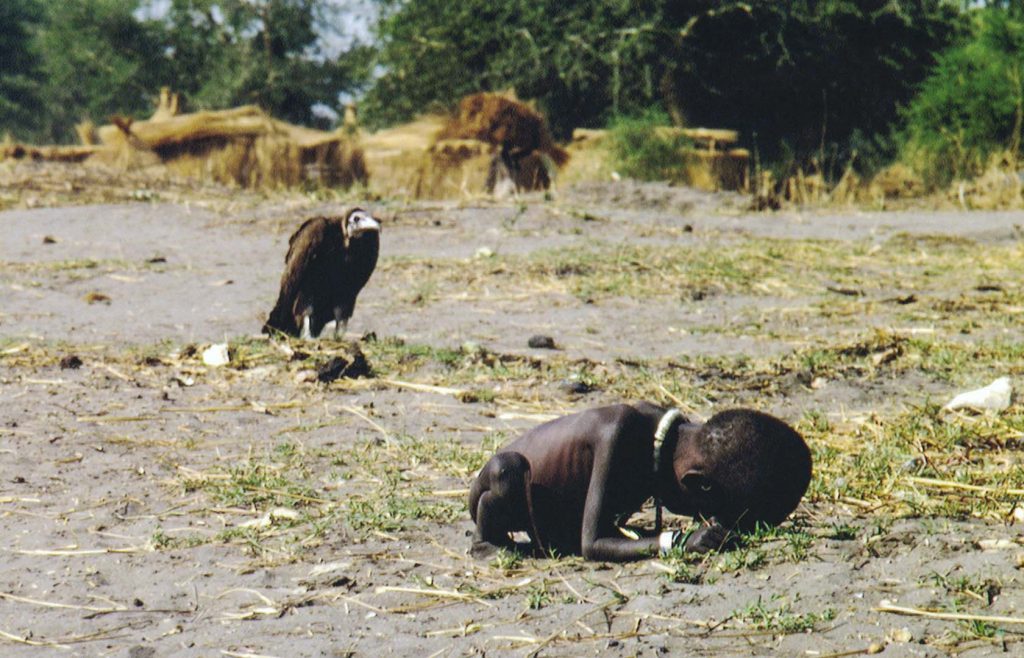
It’s into this misery that the South African photojournalist, Kevin Carter, flew in March of 1993. He wanted to capture images of the crisis. One day, after photographing all day in a camp and feeding center in the village of Ayod, he headed out into the surrounding bush to take his mind off the misery. He hadn’t gone very far when he saw an emaciated, little girl on the ground ahead of him. It was apparent she was attempting to crawl to the feeding center.
He had been advised not to touch the refugees for fear of contracting whatever disease they carried so all he could do was take out his camera and take pictures. Suddenly, a vulture landed right behind the child.
For 20 harrowing minutes, Carter watched as the vulture stalked the girl. As he took pictures, he hoped the vulture would fly away but it didn’t. Finally, he managed to shoo the vulture away, smoke a cigarette and leave.
Carter later sold the image of the vulture stalking the little child to the New York Times. The Times published it on 26 March 1993 as a “metaphor of Africa’s despair”. In 1994, Carter was awarded the Pulitzer prize for that image.
Two months after winning the prize, he committed suicide. He was haunted by questions of why he didn’t help the child. Even though he didn’t help the child, she made it to the feeding center and died 14 years later from malaria.

I have been thinking of that image of the child and the vulture a lot since the issue of the proposed towing levy in Ghana came up. It may sound a bit far-fetched that I would see a link but there is an underlying theme in all of this that weaves around the issues of hopelessness, scavenging and greed.

The issue of a towing levy in Ghana came up because of a problem. The problem is that drivers often abandon their broken-down vehicles on the sides of our already narrow and unlit roads. These become dangerous obstacles at night and have led to many vehicle accidents and deaths.
Most of these vehicles are not really road-worthy to start with, but people drive them anyway. They have to because in a country where jobs are scarce and prospects are hopeless due to corruption, greed, avarice and bad governance, one has to make a living one way or the other. So people drive these jalopies, eking out a living transporting goods and passengers till they break down, at which point most drivers just walk away.
Enter a man who believes he can fix the problem. He would tow away all these deserted jalopies away for a fee that would be paid through a levy that all Ghanaian vehicle owners would pay.

Now let’s compare this scenario to Sudan in 1993.
The country had a problem. Whereas the Ghanaian problem is that of abandoned vehicles on roadsides that lead to deaths, theirs was a famine that also led to deaths.
The Ghanaian is forced by corruption, avarice and bad governance to drive these death traps so as to eke out a living. The Sudanese was starving because of war.
While the Ghanaian had to drive these jalopies to a destination (the feeding center) in order to make money to feed themselves and their families, the Sudanese had to make it to a literal feeding center to get food.
Sometimes, the mode of transportation broke down and one could not reach the “feeding center”. For the Ghanaian it was that road-unworthy truck, for the Sudanese, the human body.
In both scenarios, leaving the “bodies” on the streets led to deaths. In Sudan through disease, in Ghana through accidents.
When the breakdown occurred and the mode of transport was abandoned, that is when they would appear.
The Scavengers.
In Sudan, it was the vultures. In Ghana, well!

However, scavengers like vultures are not always bad. They are part of Nature’s plan. Theirs is to remove the remains of the “vehicles”. This way, they do not cause disease in the Sudan or accidents in Ghana.
The problem arises when the scavengers stalk the living like in the Kevin Carter photo or the Jospong Group plotting to scavenge the wallets of Ghanaians, even those not “crawling towards feeding centers”.
It is such situations that if a Kevin Carter does not appear or a public outcry does not ensue, the scavengers stalk and finally pounce on their helpless prey, draining them of any life they may have had.
That is why it is incumbent on all Ghanaians to stay vigilant and voice their opposition to this towing levy. It is nothing more than a scavenger preying on the living. Ghanaians as a people need to fight the avarice, greed and bad governance that enable these scavengers to thrive and prey on the living. Like a war that brings about a famine, these vices are ravaging our society and making us seem like carcasses to vultures and hyenas.

Even if victory is apparent, the public should never fall asleep then a vulture is known to be very patient and has amazing situational awareness. It does not hunt but seizes the resources available to it. In a country racked by corruption, avarice, greed and bad governance, the vulture welcomes each day with wings wide open, facing the morning sun. It knows that each day brings new prey then the bodies will forever lie along the roadsides that stay narrow, dark and unlit.

Carrying the Economy Around

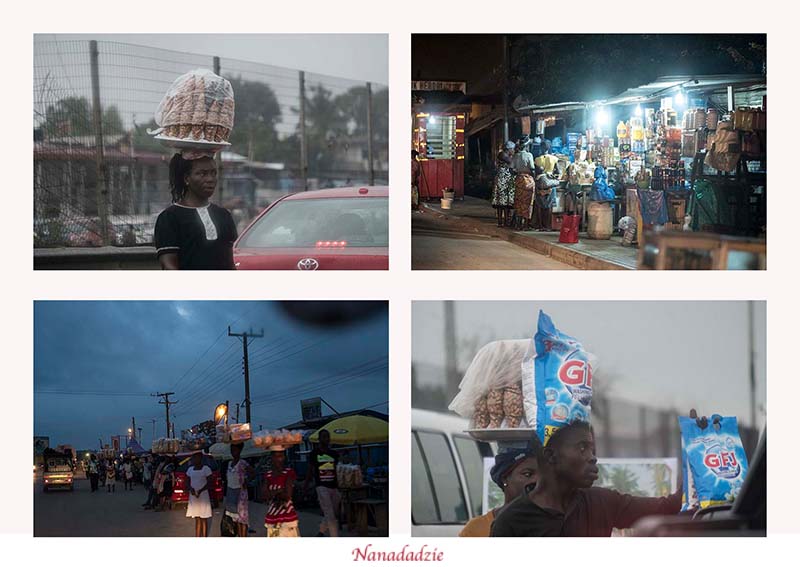
Recently, I drove from Accra to Elmina. I took my camera and a 300mm lens with me. My plan was to capture portraits of Ghanaian traders who carried their wares atop their heads.
There was no shortage of them. We set off from East Legon. By the time we hit Weija, I had over 20 headshots already. Had it not been for the rain, I could easily have filled my 8 gb card with images by the time we got to Kasoa (I shoot in RAW).

A large section of the Ghanaian economy is carried around on the heads of traders, keeping it mobile and accessible to many.
Another observation is how many Ghanaians are involved in trading. That sector alone must employ close to 60% of all able-bodied Ghanaians. There is also a great number of children who work as traders.
The whole of this trading economy seems to be situated along our roads. Traveling through the country enables one to sense the level of economic activity in the country.
With the large number of Ghanaians stuck trading, are the other sectors of the economy neglected? Are too many people chasing just a small section of the pie?
Isn’t it the case then that foreigners who emigrate to our country, like the Chinese, Indians and Arabs find all the other sectors untapped and are able to exploit them unhindered?
Why is trading the main economic activity in our land?
Can it be due to how expensive credit is in Ghana? With high interest rates and short lending times, any one who borrows money in Ghana is under pressure to turn the principal over as quickly as possible in order to be able to make payments to the lender. No other sector allows this as much trading. Foreign businessmen often have access to cheaper loans with longer lending times. They are thus able to invest in other sectors of the economy where time is kinder.
Can this also be due to an inherent Ghanaian inability to delay gratification? We know what we want and we want it now. There is no patience for the long-term. It is even seen in how we drive. Trading is the sector that corresponds more to this impatience.
Then is an educational system that honors “What you know” more than “What you can do”. This onus on “What you know” breeds a populace that does not make things. Those sectors that cater to those who make things is starved.
Instead we all trade with a distinctive portion carrying their wares atop their heads in a bid to get them everywhere – our own version of mobile trading.
The head contains the brain, the most important organ in the human body. Harnessing it allows one to do the most with life. Not harnessing it dooms one to a life stuck in just a small section of what is possible in this life, like the Ghanaian economy. It is almost metaphorical.
Is it any wonder an educator once claimed that “the head is used for carrying”?
This inability to “make things” that feed our needs is a glaring sign of a lack of creativity. An almost pathologic inability to innovate. This brings me to a story the great Warren Buffet once told.
Warren Buffet did an interview in 2008 in the aftermath of the financial crash with Charlie Rose of PBS.
Rose asked him, why in spite of so many seemingly smart people, the crash occurred.
Buffet attributed it to the 3 “I”s.
The Initiators, Imitators and Idiots.
A business cycle or idea is started by the Initiators.
The Imitators see a chance to make money and jump on board.
Lastly come the Idiots who never bother to really learn the ropes well and end up messing everything up.
So let’s take Ghana into consideration. The nation abounds with Imitators and Idiots. Where are the Initiators? Without them, we’ll forever go round in circles.
So maybe one day, we’ll set that load of merchandise down and instead use what in in that head to think up ways to diversify Ghana’s economy into other sectors.
Until then, we’ll carry our economy around.

Those Miracles

When one looks at US Health Care from a global perspective, the numbers are not pretty. Compared to other industrialized nations, the US spends way too much money on healthcare but has some of the worst outcomes. Where the US shines though is in cancer care, where only Japan and Sweden do better.
The mortality from ischemic heart disease is especially galling. Looking at 2013 figures, the US mortality is about 128/100000 (0.128%) versus 35/100000 (0.035%) for Japan. Out of 12 nations looked at, the US did only better than New Zealand. This is however easy to explain when one looks at the lifestyle choices of most Americans versus the Japanese as well as access to primary health care in both nations.
In spite of these discrepancies, those of us who work in the system see the effort that most healthcare workers put in daily to achieve good outcomes. Every now and then, some of these outcomes makes one think of a miracle. Someone may even wonder if a Deity has a hand in these miraculous outcomes. Yet if one sits back and analyzes what it took to achieve some of these really amazing outcomes, one sees the expenditure of something more than just faith and prayers.
Now imagine a 60-year-old man, who is a smoker, obese, with uncontrolled diabetes and high blood pressure. He shows up in an ER with an ST-elevation myocardial infarction and is looking rather bad. In less than an hour, a top-rate cardiologist has him in the cardiac catheterization unit and diagnoses severe 3-vessel disease and congestive heart failure that needs surgery. In no time, the cardiac team is ready and the poor fellow is the operating room getting prepped for coronary artery bypass surgery. He has the best cardiac surgeon in the hospital, an excellent cardiac-trained anesthesiologist, a tip-top perfusionist and just amazing nurses and scrub techs. Surgery goes well but his left ventricle has taken a hit so he ends up needing an Intaraortic Ballon Pump (IABP) and then a Left Ventricular Assist Device (LVAD) to make it out of the operating room. The team is worried about his prognosis.
In the intensive care unit, he is cared for by a cardiac nurse with awesome experience and nursed around the clock. A well-trained lntensivist hovers over it all.
The patient stabilizes. The LVAD and IABP are taken out a few days later. About a week later, he is out of his induced coma, has no other complications and is extubated. On post-operative day 8, he is in a chair, looking like nothing happened. His family, expecting the worst now look at him like he is Lazarus walking out of the tomb. He is a miracle!
Which brings me to that something other than faith – Money! This poor man was saved because there were resources to save him and those resources were bought with and paid for by money. He lives in a society that can buy him a miracle! Sure, the prayers of his family may have improved his outcome but those same prayers will be of no use if he had this myocardial infarction in a Third World country!
Now let’s look at the cost of this miracle (these are averages):
The ER visit cost about $2000.
Diagnostic Cardiac Catheterization cost about $2600.
Cost of coronary bypass surgery is about $70,000 to $200,00 (with his complications and assist devices, more like the upper end).
ICU stay cost about $10,000 a day for the ventilated patient, so about $80,000 in his case. I have not even added the cost of the LVAD and IABP.
The above charges are mainly hospital charges. Drugs are not included. Neither are some personnel and ancillary charges.
This was one expensive miracle, only possible in the developed nations of the world. Even in these countries, one has to ask if it is really feasible to spend so much resources on one person. Most people would want such care for themselves and family members if ever in such a situation. Who wouldn’t? is it feasible though in the long term? Can any nation afford this, even the mighty USA?
A British economist, Lionel Robbins, once gave the classic definition of economics. He stated that “it was the study of the use of scarce resources which have alternative uses.
I borrow that definition as I ask the question:
“Can we continue to use the resources we have, which may not be scarce but could have alternative uses, to achieve these medical miracles without any consequences?”
Most patients do not really care but I think we as providers should. Even in the US, nothing last forever.

The Curse of Cassandra

“Yet, mad with zeal, and blinded with our fate,
We haul along the horse in solemn state;
Then place the dire portent within the tow’r.
Cassandra cried, and curs’d th’ unhappy hour;
Foretold our fate; but, by the god’s decree,
All heard, and none believ’d the prophecy.”
– From Virgil’s The Aeneid 2.323.

In Greek mythology, Cassandra was the daughter of King Priam and Queen Hecuba of Troy. Her brother was Paris, the man whose abduction of Helen, wife of Menelaus of Sparta, started the Trojan war. Her other brother was the brave Hector, a hero of said war.
She was described as beautiful, elegant, intelligent, charming, insane, and cursed.
Legend has it that Apollo, the Greek God of Healing, Light and the Truth fell in love with the young Cassandra. She promised to be his lover so he blessed her with the gift of prophecy. Well, when the time came for her to keep her promise, she spurned Apollo. Well, hell hath no fury than a Greek God spurned and so Apollo cursed her that even though she would prophecy, no one would ever believe her.
So no one believed her when she warned that Paris’ abduction of Helen would lead to war and the destruction of Troy. Neither did they believe her when she warned the Trojans not to drag the horse they found outside the city walls into the city.
After Troy fell, she was assaulted by Ajax, one of the Greek heroes and then given to King Agamemnon as a concubine. He took her back with him to Mycenae. Even though she prophesied that they would be killed on their return to Mycenae, Agamemnon did not believe her. Well on their arrival in Mycenae, both of them were murdered by Agamemnon’s queen, Clytemnestra and her lover.
With her constantly prophesying and no one believing her, it is any wonder she was seem as bring insane?

Cassandra has come to stand for those whose words of warning are never heeded. Those who see foresee the misfortunes that await, but are laughed off as “Chicken Littles”.
It could also stand for those who are blessed with gifts that they cannot harness or can harness but just seem unable to make any personal, societal or financial impact with those gifts.
How frustrating it is to be blessed with a gift that seems to go to waste! These feelings of helplessness, uselessness and futility are enough to drive one mad. They are powerful enough to make one wish to end it all. One wonders if the Gods have conspired to play a cruel joke on these poor souls. It is as if the Gods have colluded to destroy these gifted ones by driving them mad. It almost confirms the saying, “Those whom the gods wish to destroy, they first make mad.”

So it begs the question, “Why?”
Why are some gifted ones never heeded? Why are some talented ones cursed into utter oblivion and nonfulfillment?
Could it be that like Cassandra, they reneged on a promise to the Gods? That these gifted men and women spurned the Gods? Could it be that their condition is just a price they are paying for betrayal?

In promising to be with Apollo and then later spurning him, Cassandra exhibited a lack of trustworthiness, a lack of character. This is what brought the curse on her.
Could it be that these gifted but unheeded, these talented but unfulfilled people are in this position because of the lack of character? That it may not be a curse at all but a case of deficient moral rectitude that breeds distrust in them? Maybe the curse of Cassandra is not a curse at all but a lesson in how important character is in life. That irrespective of gifts or talents, character may be the most important of all traits, gifts and talents. Maybe Heraclitus was right after all when he wrote that a man’s character is his fate.

Or maybe I am full of hot air and really, only the Gods know!