
Mfantsipim rose out of a spirit of social responsibility, and that spirit has survived the test of time and is evident in the lives of many Old Boys who work to improve the lives of many through medical research, clinical medicine, public advocacy, education, and so on.
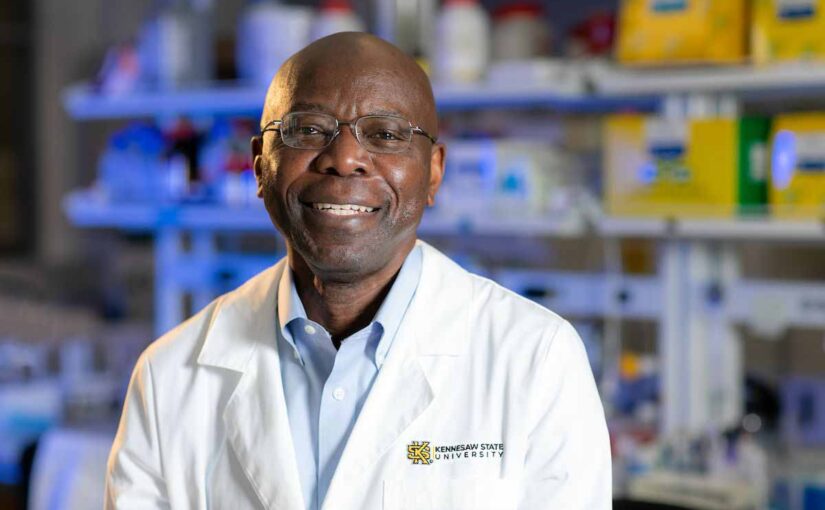
The Old Boy I present in this profile is such a person. He is Professor Kojo Mensa-Wilmot. Kojo is a molecular biologist and a renowned research scientist. His work centers on tropical parasitic diseases, with his primary area of interest being Human African Trypanosomiasis (HAT), better known as sleeping sickness. He was, until recently, Dean of the College of Science and Mathematics at Kennesaw State University in Georgia, USA, a position he has given up so as to concentrate fully on running his research lab.
Kojo entered Mfantsipim in 1969 and graduated in 1976; he is MOBA-74. He was in Balmer-Acquaah and became prefect of the upper dorm in 6th form. He credits that experience with teaching him a lot about working with others and leadership. It was also at Mfantsipim that a teacher, Richard Snell, fostered a lifelong interest in Chemistry. Kojo still remembers that time fondly and with gratitude.
After his A-levels, he was admitted to the University of Ghana, Legon, to study Biology. After taking organic chemistry classes, he soon found that subject more exciting than biology. He credits Professor Torto’s enthusiasm for teaching the subject as the reason he found organic chemistry so much more interesting. Also, some faculty in the Biochemistry department were studying parasite enzymes, and their work helped sow the seeds of his interest in parasitic diseases. Then, Dr. Peter Larway from the department introduced him to the discipline needed and the challenges one faced in designing biochemical studies and performing the necessary experiments.
One day at the British Council Library, he read about a researcher called Ernest Bueding who worked at Johns Hopkins University in Baltimore, USA. His area of research was the treatment of the parasitic disease schistosomiasis, a parasitic bloodworm found in Ghana and other countries in Africa, Asia, and South America. He resolved that day to apply to Johns Hopkins so he could work with Dr. Bueding.
So after graduating with a degree in Biochemistry from Legon, he headed to Johns Hopkins in Baltimore. Unfortunately, Dr. Bueding had retired, so Kojo switched his goals and pursued his master’s in Biochemistry at the Department of Biochemistry at the Johns Hopkins Bloomberg School of Public Health. Kojo so impressed the faculty that he was sponsored for his doctoral work.
Settling on the nascent field of Molecular Biology as the area for his thesis, his advisor was Roger McMacken, an expert in DNA replication. By transferring the DNA of a virus into bacteria, McMacken got the bacteria to produce the proteins encoded by the virus. This enabled the study of these proteins, their interactions, and their functions. He finished his PhD under the mentorship of McMacken in 1988. Through the process, Kojo realized that he had found a way to study parasitic diseases: he could grow parasite DNA in bacteria, extract and purify the proteins produced. He could then study how these proteins worked and/or whether they were suitable targets for drugs to treat parasitic diseases.
And so, in 1989, he began a Rockefeller Foundation postdoctoral fellowship in the laboratory of Professor Paul Englund at the Johns Hopkins School of Medicine, where he studied the molecular biology of the African trypanosome.
In 1992, he was hired at the University of Georgia (UGA) in Athens, USA, as an assistant professor in molecular parasitology. He also won a highly competitive national award – the Burroughs Wellcome Fund New Investigator award. Valued at about $500,000, it allowed him to set up his research lab and continue his work on finding a treatment for sleeping sickness.
In his close to 30-year stay at the UGA, some of the significant achievements he had were:
– he found compounds that could be re-purposed as potential treatments for HAT, like Curaxin-137 (CBL0137);
– he discovered a previously unknown cellular pathway through which proteins migrate within the trypanosome under environmental stress; this pathway opens the door to possible treatments against a host of other parasites.
– his lab, employing and perfecting a technique called ‘Kinase Scaffold Repurposing”, repurposed a drug used to treat breast cancer called “Laptinib” to target kinase enzymes in the parasite;
– he published over 80 papers in scientific journals and has been cited over 1800 times;
– he rose to become professor and chair of the Department of Cellular Biology at UGA, and chair of the Division of Basic and Translational Biomedical Sciences within UGA’s Biomedical and Health Sciences Institute;
– he secured a $2.6 million NIH grant for his work in 2017;
– he mentored and actively encouraged the recruitment of minority graduate students;
– In 2017, he was elected as a lifelong fellow of the African Academy of Sciences in recognition of his global contributions to tropical medicine and molecular biology.
In August 2020, Kojo left UGA to become the Dean of the College of Science and Mathematics at Kennesaw State University (KSU). In addition to his administrative duties, he continued his research work at Kenessaw. He also secured additional NIH funding in 2021, totaling $3.3 million.
As noted above, the impact of his work is evident in the research dollars he has attracted. Also, at the inaugural Roger L. McMacken Jr. Lecture program at Johns Hopkins in 2023, he was one of two former alumni of Roger MacMacken’s lab who were invited to deliver remarks. Kojo was instrumental in establishing a scholarship at the Johns Hopkins Bloomberg School of Public Health in honor of his mentor.
He has been a trailblazer, too. He is the first black PhD graduate in Molecular Biology from Johns Hopkins Bloomberg School of Public Health, the first black to chair a science department at UGA, and the first black dean of Science and Mathematics at KSU.
Kojo Mensa-Wilmot epitomizes the integration of all the lessons that time spent on Kwabotwe Hill imparts – discipline, hard work, service, thoughtfulness, and foresight. These qualities have guided him to the top levels of scientific research in the US, and, true to how he was nurtured at Mfantsipim, he is putting his knowledge and skills to work to help solve a problem that afflicts the people who live in the country he comes from. He also helps grow scientific knowledge and trains future scientists. In that, he shows a sense of purpose that the Founding Fathers would be proud of. In everything he has done so far, he has lived up to the motto, “Dwen Hwe Kan”.
Kojo Mensa-Wilmot is an illustrious son of Mfantsipim, a Botwe boy.
Congratulations to Kojo on his achievements. I had opportunity to share a room in University of Ghana, Legon with him.
Kojo indeed showed remarkable diligence in his undergraduate years. I was not surprised he persisted in his work in Sleeping sickness. Fortunately, we spent 7 years together at Mfantsipim and I can only say, Kojo well done.
Indeed, Professor Mensa-Wilmot is an illustrious son of Mfantsipim, true and true. His hardwork, determination and tenacity has propelled him to ride from the Kwabotwe Hills to John Hopkins research laboratories. The parasitology work on sleeping sickness is much relevant to the needs of poor people living along the banks of the Lower Volta Basin in Ghana. It would be exciting if Prof. Mensa-Wilmot brought his exemplary research to the University of Ghana, Legon where his research work would become more beneficial to the folks in the Afram plains and the Kpong Volta Basin. I am a contemporary of Prof. Mensa- Wilmot and I feel proud of his impressive achievements in Molecular Biology.