
When an aircraft travels above the speed of sound, it creates shockwaves. As these shockwaves sweep across the ground, they cause a sudden change in air pressure that we hear as a sonic boom. Because of its effects on hearing and terrestrial structures, scientists and engineers have sought to develop supersonic and hypersonic vehicles that produce milder, or no, sonic booms.
Rather than act on the shape, a very astute researcher and engineer took inspiration from emperor penguins and suggested another solution. While studying drag reduction at MIT in 1968, he was struck by how smoothly and effortlessly penguins move through water. He realized that when one dives into the water, thousands of small air bubbles trapped in its feathers are released. These bubbles create a cushion between their skin and the water, reducing the friction drag as water flows over their body.
Forty-seven years later, he suggested something similar for supersonic and hypersonic vehicles while working for NASA, using a laser to create a layer of ionized gas around these vehicles to disrupt the shockwaves and reduce the sonic boom. In 2015, he patented the idea.
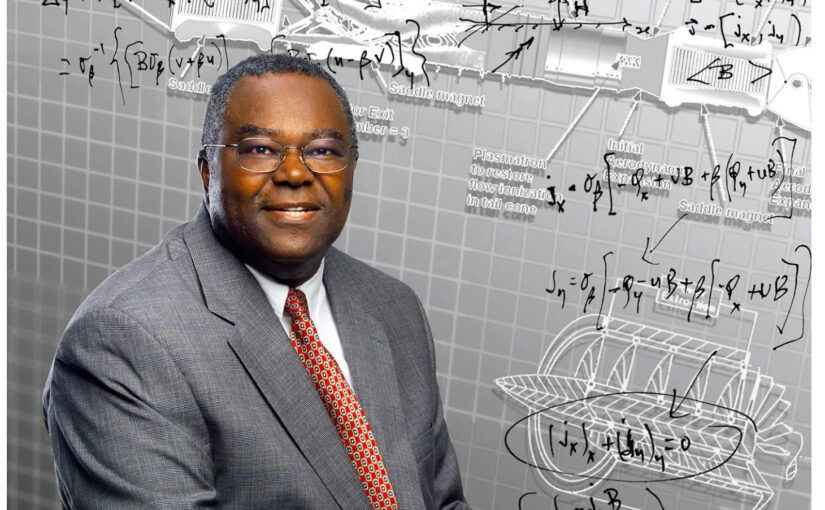
This engineer, who had the amazing ability to find solutions to aerospace problems everywhere, even in nature (biomimicry), and was a brilliant, curious lateral thinker, is an Mfantsipim Old Boy called Isaiah Miguel Blankson.
In its 150 years of existence, Mfantsipim School has seen many brilliant students come through, and this MOBA may well be one of the most astute minds to have climbed the Hill. It has truly been an honor to research his achievements.
Hailing from Cape Coast, Dr. Isaiah Blankson entered the school on 8th January, 1958. His nickname was “Ziggi”. He graduated in 1964 and his A-Level scores that year were the highest in West Africa, with 3 “A”s in Pure Math, Applied Math, and Physics.
With those impressive scores, he was sponsored by the African Scholarship Program of American Universities, a program of the U.S. Information Agency, to study at the Massachusetts Institute of Technology (M.I.T.).
He received his B.S. degree in 1969, and that year he won the prestigious Luis de Florez Award for engineering excellence. It is MIT’s internal prize for the most inventive undergraduate or graduate engineering student, and Isaiah winning it after his first degree showed his brilliance.
He stayed at MIT and completed his M.S. degree in 1970 and his Ph.D. degree in 1973, both in aeronautics and astronautics, becoming the first African to receive a doctorate in Aeronautics & Astronautics.
His thesis, which was later published as a paper in a 1975 edition of the journal of the American Institute of Aeronautics and Astronautics (AIAA), was titled “The Measurements in the Laminar Near-Wake of Magnetically Suspended Cones at Freestream Mach Number = 6.3”. It was co-authored with his MIT supervisor, Morton Finsto.
His thesis focused on wind-tunnel experiments, and he demonstrated how models could be magnetically suspended rather than using attached supports. He ionized the air in the wind tunnel, turning it into cold plasma. This allowed him to use electromagnets to suspend the cone without support, making the wake measurements in hypersonic wind tunnel testing much more accurate. He was already showing his ability to use electromagnetism to solve aerospace problems.
Now, the “plasma” he worked with for his thesis and throughout his career has often been described as the fourth state of matter. It is created when a gas is energized enough, like in a welder’s arc, a fluorescent tube, or the Sun. The energy strips electrons from atoms, creating an extremely hot mix of electrons and positively charged ions. Because it contains free electric charges, it begins to conduct electricity and respond to magnetic fields. However, because it is so extremely hot (a welder’s arc can reach 6000 deg F or 3300 deg C), scientists work with a type called a non-equilibrium, or cold, plasma. In this type, the method used to create it strips electrons from the ions while the bulk of the ions remains cold. This makes the plasma easier to work with. This is the type of plasma Dr. Blankson used for his thesis and throughout his career.
After leaving MIT in 1973, his successive careers, first at Xerox, then General Electric, and finally at NASA, were marked by research and development. From his R&D efforts flowed papers, patents, and inventions. In most of these jobs, his ability to think laterally and his mastery of magnetohydrodynamics (MHD) and plasma aerodynamics (the use of electromagnetism and plasma to manipulate gas and fluid flows) are evident.
He first worked for Xerox Corporation at their Webster Research Lab in Webster, New York, from 1973 to 1982. There, he studied electrohydro and gas dynamics.
From 1982 to 1988, he worked at General Electric’s Corporate Research Center in Schenectady, New York. During this period, he worked on hypervelocity plasma-armature projectile launchers and gas-dynamic circuit breakers. He invented plasma armature launchers that used electromagnetic forces to accelerate plasma and projectiles to hypervelocity, while his gas-dynamic circuit breakers used controlled gas flow to extinguish plasma arcs that formed within them. He also researched the gas dynamics of high-temperature powder coating operations for halogen lamps.
Isaiah left GE for NASA in 1988 and would work there until his death in 2021.
He was initially named as the Generic Hypersonics Program Director at NASA Headquarters in Washington, D.C. In 1991, he became the Deputy Director of the Hypersonics Division, a position he held until 1997.
His task was managing the agency’s new long-range program to develop air-breathing hypersonic vehicles. This was a time when NASA considered developing vehicles other than rockets for spaceflight, and the government was also interested in hypersonic missiles.
These vehicles were designed to use engines that allow air to flow into the combustion chamber at supersonic speeds. The incoming air acts as the compressor. It is rammed into a tube without moving blades, where it combines with fuel. This engine was called a Supersonic Combustion Ramjet, or a scramjet. Because it allowed air into the combustion chamber, it was termed “airbreathing.” This contrasts with more common jet engines, which use a compressor to actively draw in air.
Isaiah’s efforts included organization, research, and the publication of several papers on airbreathing propulsion, waverider designs, and computational fluid dynamics modeling. These efforts helped initiate NASA’s Hyper-X program in 1996. The program built and tested three X-43A scramjets, two of which reached Mach 6.83 and Mach 10 in 2004. From this project arose the U.S. Air Force’s X-51 – an unmanned research scramjet experimental aircraft designed for hypersonic flight at Mach 5 and an altitude of 70,000 feet.
In 1997, he moved to NASA’s Glenn Research Center in Cleveland, OH, where he was one of only 12 Senior Technologists among more than 1,250 scientists. He remained at Glenn until his passing. There, he continued his research in airbreathing hypersonic aerodynamics and propulsion, plasmas and electromagnetic interactions in gas dynamics, magnetic levitation, advanced millimeter-wave imaging technologies for aviation safety and homeland security, and water purification.
His work in those years led to inventions and patents. His first two patents dealt with engines to power hypersonic jets. The X-43A produced by the Hyper-X program lacked its own engine and was mounted to a Pegasus rocket booster launched from a B-52 bomber.
His first patent was issued in 2002 for a radical redesign of the jet engine called the Exoskeletal Gas Turbine Engine. Instead of a turbine spinning on an internal shaft, his engine used a rotating drum within which the blades extend inward rather than outward. This lowered the weight and increased the efficiency of the jet engine.
In 2004, he got the patent for his signature invention – the Magneto-Hydrodynamic Power (MHD) – controlled Gas Turbine Engine. The concept involved ionizing the incoming air just enough to make it electrically conductive, then slowing it down from hypersonic speed. The loss of speed made the air more controllable. In the process, it also lost kinetic energy, which could be extracted and recycled into the system to boost overall engine performance. It was estimated that the engine could power speeds up to Mach 7.
His third patent, obtained in 2015, addressed the sonic boom caused by shockwaves during supersonic and hypersonic flight. He detailed his methodology in a paper he presented in 2003 titled “Mitigation of the Sonic Boom by Pulsed Forward Plasma Energy Deposition: An Active Suppression Method,” and it was discussed in the first paragraph.
A 2018 patent for a Water Purification System also demonstrated his knack for lateral thinking – he applied his research on electromagnetism and plasma to water purification. In the invention, he infused water with cold plasma. Since these gas particles were charged, they could kill organisms in the water, thereby purifying it. Besides terrestrial use, he saw that as a way for astronauts to purify water on space flights.
Besides these patents, he also worked on a Millimeter Wave Radiation camera that allowed seeing through pitch-black darkness, heavy fog, dust clouds, and severe weather. It also allowed the detection of hidden weapons. The invention was deployed to enhance aviation safety during low-visibility runway landings and detect weapons during conflicts. Moreover, he continued work on magnetic levitation for testing, as in his thesis work, and space launches.
His efforts did not end in the lab – he also tried to prepare the next generation of scientists and engineers, and in that, he also mentored minority students. He helped establish research programs at Hampton and Johnson C. Smith Universities, both HBCUs with strong research reputations. Under the NASA Universities Centers of Excellence Program in Hypersonics, he served as the technical monitor/management consultant for the University of Maryland, the University of Texas at Arlington, Syracuse University, and North Carolina A&T State. He also chaired the advisory visiting committee for Penn State University’s Dept of Aerospace Engineering and for the North Carolina A&T, NASA Center for Research Excellence. In 2005, he was invited by the University of Science and Technology in Ghana to help establish a Department of Aeronautics.
He also worked with the Faculty of Physics at Moscow State University on millimeter-wave imaging research and, as a result, developed a working knowledge of Russian.
Dr. Blankson, through his prolific research, authored and co-authored over 100 papers, garnering 995 citations.
It is no surprise that he was honored and awarded for his work.
In 1969, he won the Luis de Florez Award for Excellence in Engineering at MIT after completing his undergraduate degree.
While at NASA, he won several awards:
– the NASA Exceptional Performance Award in 1990,
– the NASA Glenn Research Center’s Technical Achievement Award in 1999,
– the NASA Medal for Exceptional Service for outstanding contributions to the development of technologies for high-speed flight in 2002,
– the NASA Glenn Martin Luther King Recognition Award in 2004,
– the Presidential Rank Award — Meritorious Senior Professional in 2006,
– the Presidential Rank Award — Distinguished Senior Professional in 2014, and
– the NASA Exceptional Technology Achievement Medal in recognition of his development of non-equilibrium plasma technology for aerospace and terrestrial applications in 2018.
He was also honored often by the African-American community:
– the Black Engineer of the Year Award in 2005,
– the Science Trailblazer Award, Emerald Honors in 2005, and
– the National Emerald Honors Black Scientist of the Year Award in 2006.
In its September/October 2005 issue, “Science Spectrum”, a magazine focused on minority scientists and engineers, had Dr. Blankson on its cover and gave him the nickname “Speed Demon” for his work on cruise missiles and aircraft concepts designed to travel four to eight times the speed of sound.
Interestingly, at NASA, he was also known as ‘Dr. Speed”.
In 2019, Dr. Blankson was selected as an American Institute of Aeronautics and Astronautics Fellow and served as a reviewer for its journal.
From 1998 until his death, he served as the US National Delegate to the NATO Research and Technology Organization’s Working Group on Hypersonic Vehicle Technology.
He was a Member of the Fluid Dynamics panel of the National Academies Review Panel for the Air Force Office of Scientific Research in Hypersonics and Unsteady Flows.
He was also a member of the Advisory Board of the NASA Glenn Research Center.
Dr. Blankson’s life and career epitomize brilliance, hard work, ingenuity, and curiosity. Colleagues at NASA described his curiosity as “legendary” and praised his wisdom, intellect, and generosity in sharing ideas. Raised on the Kwabotwe Hill, these qualities are not surprising. The heights that he took them to are breathtaking. He will forever be a symbol of what the upbringing on the Hill can produce, and every Mfantsipim boy is proud of his contributions to airbreathing hypersonic aerodynamics and propulsion, plasmas and electromagnetic interactions in gas dynamics, magnetic levitation, advanced millimeter-wave imaging technologies for aviation safety and homeland security, and water purification. He passed away on November 19, 2021, at the age of 77, leaving a legacy that will outlive him.
Dr. Isaiah Miguel Blankson is an illustrious Son of Mfantsipim, a Botwe Boy.