
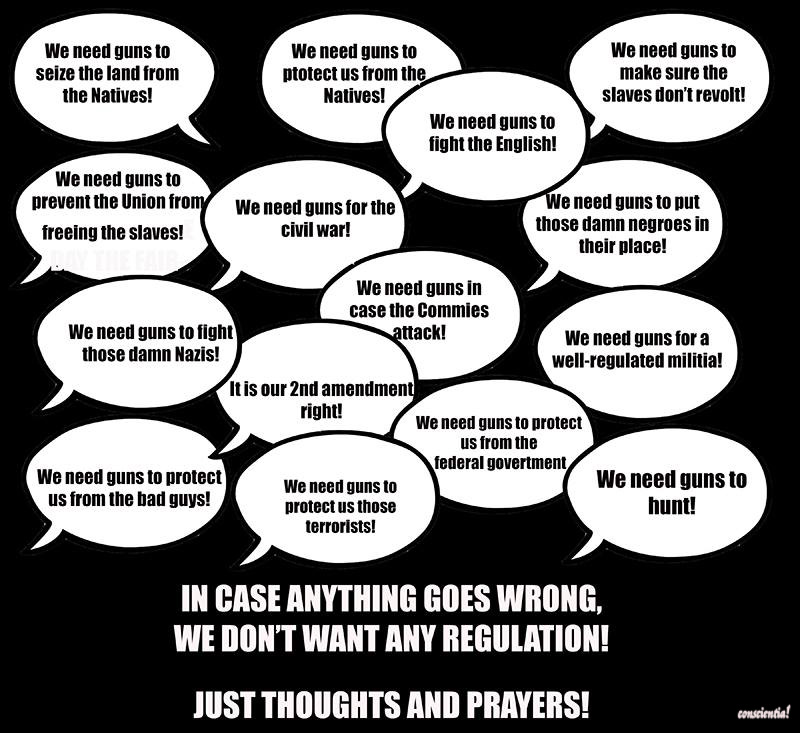
Thoughts and Prayers are not enough. Heaven helps those who help themselves.
Thoughts and Prayers are not enough. Heaven helps those who help themselves.
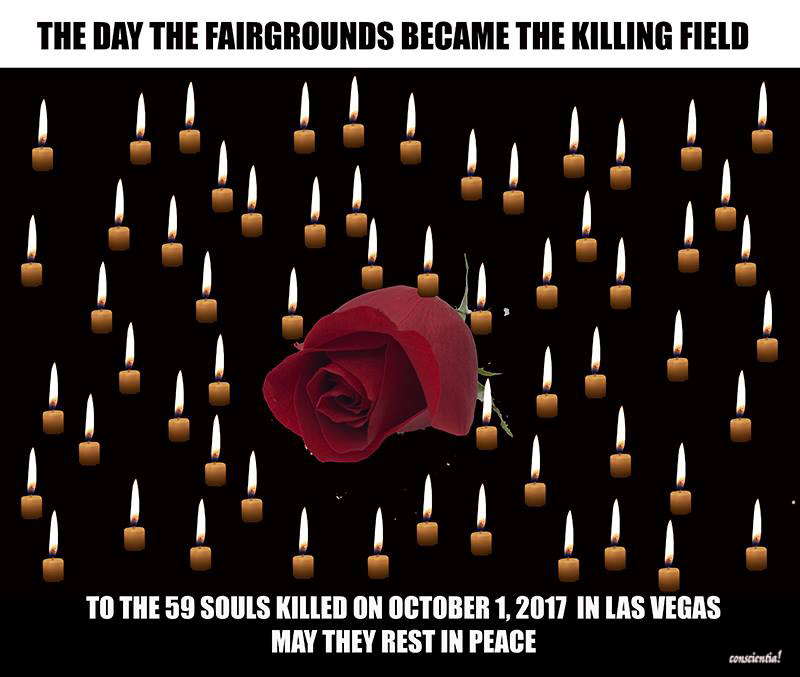
Las Vegas on my sad and weary mind…
Let’s keep a flame in our hearts and minds burning for each of them to remind us as a nation that we finally need to do the right thing…
May they all rest in peace
#VegasStrong
#GunControl

The ability and right to peacefully protest is a great privilege indeed. Not all men are blessed with that. Even if you disagree with the root cause of a protest, treasure that right. Defend it! It’s priceless!
On Wednesday, President Trump delivered a speech to the Heads of States leaders of Côte d’Ivoire, Ethiopia, Ghana, Guinea, Namibia, Nigeria, Senegal, Uganda, and South Africa at the UN.
This statement he made earned and still earns him a lot of derision on social media:
“Nambia’s health system is increasingly self-sufficient.”
You see, there is no African nation named Nambia and everyone wondered if he meant Namibia, Zambia or Gambia.
Yet with everything Trump, within the web of lies, half-truths and exaggerations, there often lurks a hint of reality on which his deck of cards is mounted.
The clue to all this is found in the first paragraph of his speech. He said:
“Africa has tremendous business potential. I have so many friends going to your countries, trying to get rich. I congratulate you. They’re spending a lot of money. But it does — it has a tremendous business potential…”
So Trump has a lot of friends who go to Africa to make lots of money.
They go to this continent racked with disease, poverty and war to make a lot of money.
So where do they go to make this money? Well, you won’t believe it but they go to…Nambia!
I can already see the looks of incredulity as you read this and the question, “Where is this Nambia, Nana Dadzie?”
Well, Nambia is not a place per se. It is an institution. Nambia is an institution that allows a continent to be exploited to an unimaginable degree.
In urban parlance “nam” can stand for “a nothing” and one of the meanings of “bia” is weakling.
“Nambia” – “a weak nothing!”
Doesn’t the continent often comes across as a weak nothing?
Yet it’s not the whole continent that is a Nambia per se.
You see, the continent of Africa is blessed with resources. Like crazy amounts of gold, diamonds, oil, uranium, land and human capital.
The institution of Nambia is that which allows only allows a few access to these riches.
In the era of early European exploration and colonialism, they traded in everything, even humans! As the Indigines languished, they amassed sick wealth.
The whole continent was sucked into a giant Nambia.
The whole continent was a weak nothing!
These days, you see Nambias in Lagos, Accra, Abidjan, Nairobi, Lome, Luanda or even Johannesburg.
The men and women who populate them are Nigerian, Ghanaian, Ivorian, Kenyan or even Angolan. They wear thousand dollar suits from Saville Row and Rolex watches bought in New York. They ride in Mercedes AMGs over potholed streets that are lined by hungry children begging for a morsel yet these men and women do not see them through their tinted windows. They live in million-dollar homes far-removed form the crumbling hospitals and dilapidated schools their poor constituents have to use.
You see, these are the men and women with power and access to all the resources the continent have.
These are the men and women Trump’s friends go to see when they go to make money. These are the men and women who cavort with the North Americans, Europeans, Japanese and especially the Chinese who want to reap the riches of the continent. These power brokers sell these foreigners access to Nambia and together, they get to enjoy this paradise. To assuage their guilt, they throw the masses a bone, a like a health center, every now and then.
In this rarefied air, the masses who are afflicted with disease, racked with hunger and killed in wars don’t get to play. They hear their nations are rich but they never see it. They hear of this place called Nambia and bid their time. if they ever make it there, they take as much as they can, propagating the cycle.
These men and women may have all the trappings of wealth but due to their greed, they are weak nothings!
So laugh at Trump all you want. He was right. His friends go to Africa to try and make lots of money. They spend a lot of money doing that but only few of the Indigines benefit from that.
The place they do that is called Nambia and unlike the rest of the continent, its health system is increasingly self-sufficient and those who populate it are far-removed from the misery of life on a continent that is poor in the midst of riches.
It always amazes me how a simple song can bring back long-lost or even repressed memories with such clarity. Music is really the soundtrack of our lives.
Whereas my son is totally into Afro-Carribean music, my daughter seems to enjoy rock classics, indie, grunge and the Motown stuff.
When we are in the car, she often loses the battle for which station to listen to by a ration of 3:1, so occasionally, I’ll throw her a bone. I did so yesterday.
Scrolling through the Sirius-XM stations, I landed on one playing a Tom Petty song she liked – “Into the Great Wide Open”.
Suddenly I was back in Leipzig, Germany. 1992 or 1993, I think. Medical School. Time for the more serious clinical rotations. I wanted the community hospital experience so I picked a hospital outside Leipzig. It was about 19 miles away and I had to be on the floor (ward) by 6 am to prepare for rounds.
I would wake up each morning when the alarm went off at 5 am, wondering whether this was how life was going to be for the rest of my life. In a mad dash, I would get ready and set off in my trusted 1989 VW Golf, still wondering. On the occasions that my then girlfriend spent the night, I rushed out with her still sleeping soundly without a care in the world. I was always so jealous of that.
For some reason, two songs stuck with me on those commutes. They would play often on the radio station I listened to. Both were by Tom Petty from the album “Into the Great Wide Open”. The first song was “Learning to Fly”. The other was, well, “Into the Great Wide Open”. I remember one particular morning in the dead of winter when there was quite a bit of snow so that traffic had slowed to a crawl. I knew I was going to be late. The sky was grey and I wished I was back in bed. In the space of 15 minutes, the DJ played both songs. That day, I was struck by the words.
The refrain of “Learning to Fly” goes:
I’m learning to fly, but I ain’t got wings
Coming down is the hardest thing.
That of “Into the Great Wide Open” went:
Into the great wide open
Under them skies of blue
Out in the great wide open
A rebel without a clue
To be honest, I found the songs quite unhelpful. One told me I had no wings and the other said I was clueless. The songs somehow reminded me of how alone I was – far away from family, “in the great wide open”, trying to grow my own wings so I could fly. Even back then I knew coming down was not the hardest thing. What was the hardest thing then?
As the song played on the radio yesterday and I was taken all the way back, I felt those sharp pangs of nostalgia.
The years have gone by since those days when I drove to Borna from Leipzig but I must say those words have proven to be quite true.
I ventured into “the great wide open” all by myself and so far, I’m surviving. I have fallen often because of the immaturity of my wings. I still do but I am not giving up.
And that “…without a clue” thing, how right was he! After all these years, I still wake up at 5 am, still steal out of the house careful not to wake my wife and kids and still wish I was back in bed.
And then as the song finished playing, it hit me. Coming down is not the hardest thing. It’s having the courage to take off again. Again and again even though the wings are not ready or immature. Knowing that you may come down much sooner than later but doing it anyway…..over and over in spite of crashing repeatedly till one day, you stay up…..maybe even soar to the heights like an eagle.
The years teach you that. Finding it in myself to wake up each morning even when I didn’t want to taught me that. Overcoming fears, anxieties, bad habits, procrastination and just doing it teaches that.
It took my daughter’s taste in music to remind me of that.
One day when she and her brother get ready to step into the world, I may send them off with some Tom Petty. He was a good companion to me once upon a time. Maybe he will be a good one to them too….in the great wide open.
Suffering and misfortune are as part of life as the air we breathe. The late Chinua Achebe, the great Nigerian writer, captured this fact superbly in a quote from his book “Arrow of God”:
“When suffering knocks at your door and you say there is no seat for him, he tells you not to worry because he has brought his own stool.”
In this quote, part of a speech by the character Moses to the elders of the town of Umuaro, he compared the folly of not accepting the fact that the white man in the then colonized Nigeria had all the power to not accepting the inevitability of suffering in life.
Just like the European showed up on the African shore with his own stool and took over, regardless of the fact that the latter did not invite the former, so does misfortune sometimes intrude into our lives without an invite and takes over.
I look at the misery imposed on the people in Houston and other parts of southern Texas, Sierra Leone and Mumbai and cannot but think of how suffering walks around with its own stool.
So if we humans hate to suffer, why do we do things or make decisions that invite misfortune into out lives? I’ve always wondered about this and somehow, the miserable images on TV in the last few days have amplified this deliberation.
All that musing brought to mind a verse from a poem by Samuel Taylor Coleridge, “The Rime of the Ancient Mariner”.
The story of the mariner in the poem contrasts greatly with the story of the people in Houston – he brought his suffering upon himself, the people of Houston did not. However, in both instances, water played a great role in the nightmare that ensued.
So a brief synopsis of the poem – a mariner, his crew and their ship are headed on a voyage. A storm drives them towards the Antarctic. Lost, they got caught in ice. Suddenly, an albatross appears and with it a wind that leads them out of the icy debacle. All is well as they follow the albatross but then the mariner shoots the bird with his crossbow and kills it. Following that, it was as if the gods and spirits had conspired to punish them. The very wind that seemed to have lead them out of the ice of the Antarctic lead them into uncharted tropical waters. Lost, all of a sudden the wind stopped. The ship just sat in these unknown waters, immobile. All his men blamed the mariner for their misfortune. It was in these dire circumstances that Coleridge wrote these lines:
Water, water, every where,
And all the boards did shrink;
Water, water, every where,
Nor any drop to drink.
Water, water everywhere indeed!
I’m sure the people of Houston look out and say that to themselves and wonder why such misfortune was visited upon them. Unlike the mariner in Coleridge’s poem, they never shot an albatross!
Well, like Achebe wrote, suffering walks around with his own stool. He imposes himself even if you do not want him!
Going back to the poem, the mariner is forced by the death of his crew and him being alone with the corpses on that lonely immobile ship to learn to appreciate life and realize how senseless the killing of the albatross was. From the misery, he grew. He found the proverbial silver lining.
So, is that why suffering marches around with his stool? To force us to learn? Are those who make mistakes and dare misfortune the ones who are more apt to learn faster? Is it that the majority of us fail to grow, so suffering has to knock on that door and induce misery so we can learn? Is suffering really the only way to sometimes learn the harsh lessons of life?
Is that why in both scenarios water seems to be the common denominator?
You see, water is life but in the case of Houston, Sierra Leone and Mumbai, it has became the killer! How can life turn on itself? How can life connive with suffering? Could it be that life itself wants us to grow? That life itself thinks the only way for us to develop and be greater is through misfortune? Water…it calls to mind the Christian custom of baptism, rebirth renewal…
Water, water everywhere!
Maybe, when we open that door and suffering is out there, we should gladly invite him in. We should tell him:
“As miserable as you look, I know there is a silver lining in you. I am going to find it so set that stool in the corner and sit down.”
In all this water and suffering, I hope Houston and the rest of Texas, Sierra Leone and Mumbai find the silver lining.
All over the world, wherever the English introduced their language to the Indigenes, an adulteration of the English language ensued. It got mixed up, slanged, patoied, pidginized and even drawled out.
It was no different in Ghana where we not only made English our official language, but also created our own pidgin version out of it. Not satisfied with that, we borrowed a few words to add to our everyday discourse. In the process, we have at times so altered the meanings of the original word or phrases that not even Chaucer will make them out.
Sometimes, we translate directly from the vernacular into English, using that literal translation as an expression. A good example is the expression, “skin pain”, a term that means “jealousy”. In the Akan language, jealousy is “ahoa” (skin) “yaw” (pain) and just like that, we have a term.
One old and popular phrase that is probably older that most living Ghanaians can remember is the term “distin”. The term was birthed from the phrase “this thing”.
The term was used to describe anything or any event whose name the speaker could not remember or did not know. Often these were people whose command of the English language was fragmented. However with time, it got into popular usage. Following is a good example of it’s use:
Remember back when cellphones first appeared on the market. If I tried to describe one to a friend and I couldn’t remember the name, I could have said, “I saw “distin” you can use to make calls that is wireless”.
Boom! I didn’t miss a beat!
Thus “distin” grew and with time became the Swiss Army knife of everyday Ghanaian conversation, morphing into other branches of our discourse.
So now, one can hear the term, “It was a sad distin” meaning “It was a sad day or It was a sad event”.
The term has also crept into our bedrooms where all things conjugal fall under the broad umbrella of “distin”. Here one even hears variations like “to distinate” or “the distinate”…..I’ll leave the meanings to your imagination.
Matter of fact, all parts and participants of that male-female interaction can be described with “distin”:
“His ‘distin’ doesn’t work anymore but that is not catastrophic since we live in the age of Vitamin V”, Ama confided to Abena.
One can only marvel at the versatility of the word!
I cannot end distin without my favorite “distin” story.
This past July, I was in Accra with the family and took the kids to Coco Lounge at Stanbic Heights for brunch. Street-level parking was full so we used the underground lot and thus, had to take the elevator up. The minute my son saw the elevators, as he is wont to do, he ran over to the door and starting pushing repeatedly on the call button.
Suddenly an attendant appeared like out of the blue. He was an older guy. He pushed my son’s hand away from the call button and yelled:
“Why you pressing, pressing, pressing? Don’t you know you’ll break the distin?”
At that moment, all I could imagine was my son breaking a distin.
I still laugh when I remember that funny distin.
Let do a simple imagination experiment.
It’s late 2006. Out there in the universe is a planet inhabited by aliens as curious as the human race. They have been exploring the wide blue yonder and chanced upon the planet Earth. Let’s call this alien planet “Ahom” and the aliens that live on it “Ahomfians”.
Now these Ahomfians are different than us. You see, they cannot see us humans. They however see structures. They see our homes, churches, skyscrapers and mobile homes. They are fascinated by them.
One of the Ahomfian explorers recommended studying our planet. Their ruling council agreed. The explorer designed a study to look the strange structures on our planet. He picked a random street somewhere in the suburbs of Middle America with beautiful single-family homes.
A team of Ahomfians was sent down and these aliens fitted all the homes on this random street with a multitude of sensors. When they returned to their planet, they were able to monitor parameters like temperature of the homes, heat emission, sounds and vibrations.
The study started in 2007, a year before the crash of the real-estate market.
The 30 homes on that street were all new constructions and and all of them but five were occupied. The Ahomfians, unable to see the humans in those homes, noticed a difference in heat emissions and other parameters between those homes and the other 25. The 25 homes felt “alive”. The others seemed “dead”.
Then 2008 came around and the economy crashed. All of a sudden, more of the homes seemed to “die”. By the end of 2008, only 10 of the homes were “alive”.
The aliens wondered what had happened.
Then after about a year, things seemed to change. More of the homes started to come “alive”. The heat emissions went up. The homes emitted more vibrations and sounds. By the end of 2009, all the homes were emitting heat and sounds and seemed “alive”
After 5 years, the team wrote a report. Their conclusion was on the new planet they had “discovered”, there were immobile structures that seemed to go through several life cycles, the timing of which was quite unpredictable. They recommended more studies.
Now if these aliens could see us humans, they would have realized that these homes come “alive” when they are occupied and feel “dead” when they are not.
Makes one think of life, doesn’t it? Doubt me? I’ll show you.
When one has life, the body is alive. Death ensues when life ends.
Aren’t our bodies just receptacles for whatever makes us alive, just like those homes the aliens studied? Thus when a body is occupied by this life agent, that human is alive but dies when that agent leaves? The spiritually-inclined will call this agent the soul and make it responsible for the gift of life.
Or is it?
Let’s go back to homes analogy and think of what makes a home worth living in. It has to be structurally sound, affordable for and attractive to the buyer and in a fitting neighborhood. If any of those things change, homeowners tend to sell and move on. Thus homes that suit this bill tend to attract buyers and thus become “alive”
If we go back to the body, can we also apply this analogy?
One may say that there are biological factors that are conducive to life and when they are absent, life escapes. Can it also mean that if one was to construct a body, say out of stem cells, such that it was receptive to life, it could come alive? Would this life agent find this body and occupy it?
Let’s take this a step further. Is life created when a biological system becomes viable. So if I were to use stem cells to create all the various human organs and string them together into my own Frankenstein so his heart beats and his neurons I grew in the lab seem to transmit messages, would he come alive? After all, he would be biologically viable.
I guess my question is the age-old query: “What is life?”
Is it a spiritual occupation of a human body, making it alive or does life ensue as a result of viable biologic processes?
If one believes in the former, then life and death are all-or-nothing processes. You are alive then you die. Dead or alive! No protracted transitions. One can disagree with my premise and cite the myriad examples of people who had near-death experience s and their stories. That somehow, the life agent or soul has a change of heart and returns, restoring the viability of the body’s biological systems. Which further illustrates the point that this school of thought attributes the viability of life to the life agent.
However, if one believes in the latter, then life and death are not all-or-nothing. Then as long as we can prolong the viability of those biological processes, life hangs around to a degree. As long we can keep the CPR going, as long as we can cool the body to 18 degrees Celsius, as long as we can keep up with the blood loss, there may be a chance. Then life is a result of biology not the effect of a life agent.
What is life?
I think I’ll play an Ahomfian card and say, “More studies are needed”.
On April 25, 1884, Sir Walter Besant, an English historian and novelist gave a lecture titled “Fiction as One of the Fine Arts” at the Royal Institution in London.
In the lecture, he argued that the novel was an artistic form like a poem or a painting, that the writing of a novel was governed by laws that a writer should master, that a writer should have artistic talent and moreover, a novel should aim to raise a readers’s moral conscience. Back then the novel was seen as an unserious literary form.
The lecture was published a month later in a newspaper with the title “The Art of Fiction” and led to a series of rejoinders by several writers of the day. Among them was the British-American novelist Henry James.
The response by Henry James, which he published in September 1884 was also titled “The Art of Fiction”. In it, although he agreed with Besant that the novel is a work of art, he took issue with the former’s proposal that the writer of a novel be guided by laws. He maintained the most important job of the novelist was to make sure the story was interesting.
One other point he agreed with Besant on, is that characters in a novel should be clearly defined. In the 7th paragraph of the essay is this memorable quote:
“What is character but the determination of incident? What is incident but the illustration of character?”
Think about this for a minute.
This is one of this quotes that easily escapes it’s area of origin and wafts into the everyday due to it’s connotation. It’s doesn’t stay only as a guideline for the novelist but seems to carry lessons for life in general. Realistically, this should not be a surprise since a novelist tries to capture life and weave it seamlessly into a story.
So back to the quote.
The novelist may see in these lines a call to create characters in a novel who mesh into the incidents that define them and to build incidents that clearly elucidate the characters they encompass.
If one creates a character with negative traits, he must be placed in incidents that define him. However, the character’s ability or inability to surmount or succumb to his dark side and rise or fall is what should make the story.
In real life however, what does, say, the first part of the quote even mean?
“What is character but the determination of incident?….”
Does who we are draw us to certain situations in life? Does character predetermine what conditions we find ourselves in in this journey of life? To a point. I think. A drunk frequents bars and is more apt to get in a fight. An aggressive driver is more prone to get driving tickets and see the confines of a courtroom at a higher rate. An empathic person is going to hear sad and heartbreaking stories from others more than the self-centered one.
We all know of that friend who seems to always be in trouble, or the one who always suffers the worst misfortune or even she with the Midas touch.
I bet you look back and think of a trait that always seem s to land them in these situations.
Also, the words and deeds that may emanate from a character can have effects far and wide. An uncaring leader, who by his words, incites hate in a society can awaken and embolden her darker elements.
Character determines incident.
The second part of the quote is actually easier to understand.
“….What is incident but the illustration of character?”
Our character is our fate. Our character decides how we react to many of life’s vicissitudes. Our character is evident when we fail to empathize with the unfortunate or are unable to draw the right parallels and equivalences in life. When we say, equate the reaction of those who resist hate and oppression to those who seek to perpetrate and spread these cancers of society.
If we accept Shakespeare’s assertion that all the world is a stage and we are all just two-bit players in a cosmic production, then the ability to rise above our base instincts and traits and aim for a higher point is what ultimately tells the story of our lives. It is what determines the plot of our performance.
That even though our characters might place us in incidents that are negative, it is ultimately our reaction to these incidents that matter. That is what defines us.
Like Viktor Frankl wrote:
“When we are no longer able to change a situation – we are challenged to change ourselves”.
So go ahead and write your life’s novel. Fill it with joy and pain, laughter and sadness, love and hate. Make love. Sing. Dance. Who you are will determine the songs that play and even where the wind blows but dig deep and rise. Rise to let those dark incidents illustrate a strength and resolve to write the best novel ever.
The Prophet Jeremiah in the Bible was one angry prophet and he had every right to be. In his lifetime, he saw the Kingdom of Judea defeated and Jerusalem and Solomon’s Temple destroyed by the Babylonians around 587 BC. For a prophet, the destruction of the Temple was a catastrophe.
In his mind, this calamity befell Judea because of the sins of the people and was a punishment from God. His caustic rebuke of his people is evident in all three books that he wrote or co-wrote – the Lamentations, the Books of Kings and Jeremiah.
Thus, buried in chapter 13 of the book of Jeremiah is a verse that really captures his despair and maybe even cynicism. Verse 23 of that chapter reads:
“Can the Ethiopian change his skin, or the leopard his spots? Then may ye also do good, that are accustomed to do evil.”
That verse has spawned the saying, “Can a leopard change it’s spots?”, a saying which basically means that we are who we are and can never change. That our character decides our actions and we cannot be more or less that what our character is.
The metaphor is quite powerful then we know the skin color of an Ethiopian (or Cushite as in some translations) and the spots of a leopard are just unchangeable. Maybe, with developments in gene technology, that might be a possibility in the near future but now and at the time Jeremiah wrote, it is and was not a possibility.
There are many variations of this saying like, “You cannot teach an old dog new tricks” or like Popeye used to say “I am what I am” or “Old habits die hard”.
My favorite of all the variations is the German version:
“Man kann nicht über seinen eigenen schatten springen” or “You cannot jump over your own shadow”.
Being a very visual person, I have always imagined that vividly. It clearly illustrates the difficulty in overcoming oneself even more. One’s shadow is basically a light-induced extension that is impossible to separate from, or even jump over. The shadow can also signify one’s history, what one has done in the past, that upon which others draw. Is this shadow so dark that one keeps tripping over it?
Now let’s take this exercise a step further and apply the saying to not only humans, but everything that acquires an identity or develops a personality. To mind comes societies, groups of people, nations. These are entities that over time acquire a distinctive identity that has moral and ethical factions. Thus, these groups can be said to have their own distinct characters that may arise from how the majority does things or in what the majority believes.
So can we then ask if a nation, one such entity, can change it’s spots or even jump over it’s shadow?
If that nation is the US, can we ask if this nation can escape is dark history and jump over it’s shadow of racism and bigotry? Can black people be seen as humans who matter? Can we ask if whites can empathize with the lot of non-whites? Can we ask if Black America can escape the cycle of violence and poverty? Can we stop assuming that all whites are racist or that all blacks are thugs? Or are we all condemned to being who we are?
The Ethiopian stays black and the leopard remains spotted.
To continue on that tangent, let’s go back to Jeremiah 13:23 and read the last part of the verse:
“….Then may ye also do good, that are accustomed to do evil”.
As written, the statement is a bit unclear.
Did Jeremiah mean:
“Can you who are accustomed to doing evil ever do good?” or
“Even you who are accustomed to evil can find it yourself to do good?”
This uncertainty in his meaning is evident in the way this statement is translated in the different versions of the Bible that are available. One finds one of the three forms in different versions.
Yet if we can remind ourselves of how angry Jeremiah was and who he heaped the blame on for what befell Judea, then I am sure he meant:
“Can you who are accustomed to doing evil ever do good?”
He never believed in his heart that he people of Judea were capable of changing their spots or jumping over their shadow.
Events of the past few days make me feel bit like Jeremiah when I look at the US. I despair and wonder if the leopard can change it’s spots. It does not help when one hears the unscripted words of the President. His words confirm his dark spots and prove what kind of human being he is. One wonders if he speaks for the majority of White America and I wonder if the US can ever escape it’s bitter history of slavery, Jim Crow laws, lynchings and segregation or will that past always find a way to tag along like a shadow? Is the national psyche capable of inducing the nation to jump over it’s shadow once and for all? Then it feels like the leopard is still spotted.
It is evident that the President is neither going to be the leader nor the moral authority to champion such a cause. If one argues that the President speaks for most of White America, then despair rolls like the waters and hopelessness like a mighty stream.
Ever being the believer in the good in humans, I chose to believe that the majority, unlike the President, reject the bigotry and hate. If that is the case, maybe we may have it ourselves to attempt the jump over the dark shadow of our history.
As I pondered that possibility, I had a string of thoughts. Perhaps the leopard will never change it’s spots but it will learn to live with what it’s spots make it. Maybe what really matters are not the spots but what the leopard believes.
Perhaps the US will never be rid of those who believe in the supremacy of one race over the other or will seek to subjugate the other race. Of those who hate and discriminate. Perhaps there will always be pockets of racism and bigotry.
Yet if the national psyche is one of a concerted effort to jump over this dark shadow that haunts us, then when Jeremiah asks, “Even you who are accustomed to evil can find it yourself to do good?”, we can all answer, “Yes, we can!”