
I am suffering from severe case of Olympiosis.
Symptoms are quite prevalent in the mornings but are felt all day long – tiredness, yawning, red eyes, arthralgias, headache, deafness to alarm clocks and gross irritability. It can be confused with a hangover. The difference is found by measuring the blood alcohol level in most patients.
Cause is thought to be inability to extract the human mass away from a television set during the Olympic games. It was first described in the 1970s.
Most experts attribute the pathology to pure wonder at athletic prowess. Game and his team in a seminal paper postulate that the sheer determination exhibited by the athletes induces heightened admiration leading to insomnia. Track et al measured the level of light emitted from the medals the athletes receive and noticed a high correlation between the amount of gold won and the severity of Olympiosis and laryngitis.
Cases of Olympiosis spike during the Swim, Track and Beach Volleyball events. Men seem to be particularly afflicted during the Beach Volley Ball events. This year, the CDC is reporting that doctors are seeing a spike around the Ladies Gymnastics events too.
Four years ago, researchers in London isolated two viruses called the Phelps and the Bolt that might play roles in the severity of Olympiosis. This year, scientists in Rio de Janeiro have isolated two more viruses – the Ledecky and the Biles. A group outside Rio reported on a variant called the Manuel. A team at the NIH is working on vaccines.
Olympiosis might be contagious, a fact that the experts cannot seem to agree on.
Treatment is avoiding television sets. A good televisionicide will do the trick. Also, one should avoid contact with the internet in all it’s forms. Symptoms usual subside after about 3 -5 days of avoidance.
Failure to treat leads to a chronic state that is incurable. The long term prognosis is dire. It seems to lead to sundaynightfootballiosis, modaynightfootballiosis or even EPLiosis. Most chronic patients end up in rehabilitation centers, where they spend the rest of their lives watching TV and drinking beer or knitting.
A select group of patients seem not to progress to the chronic stage and I think I belong to that group so for now, Olympiosis, bring it on!
Mushi-Mushi

The Conscientia Campaign
Harnessing the power of images to raise awareness and effect change
#MonkeysAndBaboons
#TheConscientiaCampaign
On The Wall
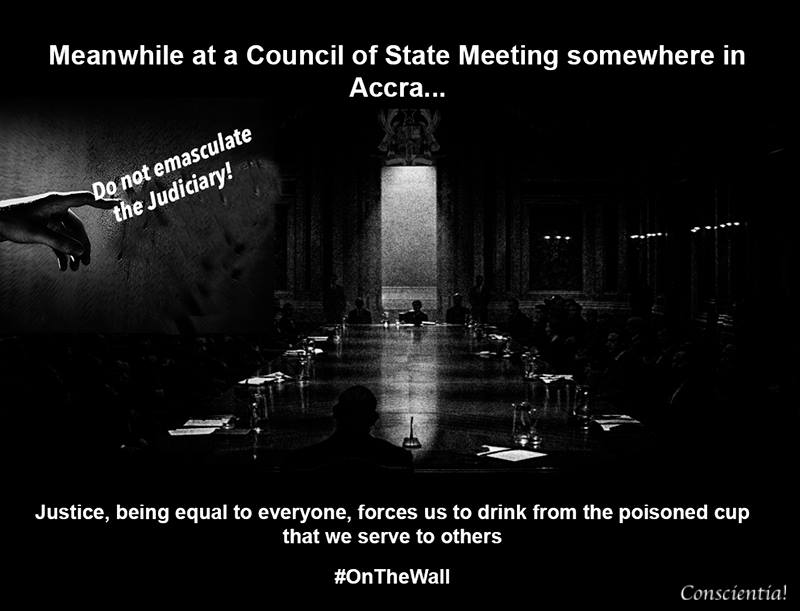
Let them be on notice that as Shakespeare wrote in Macbeth:
“Justice, being equal to everyone, forces us to drink from the poisoned cup that we serve to others”.
The Mad Doctor
“For I was hungry and you gave me something to eat, I was thirsty and you gave me something to drink, I was a stranger and you invited me in, I needed clothes and you clothed me, I was sick and you looked after me, I was in prison and you came to visit me.”
– Matthew 25:35
I dedicate today’s post to an amazing man and physician that I only recently heard about and for that, shame on me!
Dr David Fuseini Abdulai.
Dr Abdulai, born in the Northern Region of Ghana, was one of 11 children. He is the only one still alive. His siblings and parents died from poverty-related diseases. His dad contracted leprosy (Hanson’s Disease) later in life and his mum had to beg for food for the family.. After he lost his family, he lived on the streets where he often went without food. That experience proved critical in what he was going to devote his life to.
Through the help of the Catholic Church, he managed to go to school and then to Ghana Medical School. After graduation, he practiced at Korle-Bu and 37 Military hospitals till 1989 when he decided to move back to the Northern Region to give back.
And has he given back!
He founded the Shekinah Clinic for the indigent and the destitute. He founded the clinic to serve the Very Important People (VIPs, like he calls them) in his life – lepers, the mentally challenged, the crippled, in short any one who society had cast out. In parts of Ghana, lepers, the mentally challenged and the crippled are often homeless. From his childhood experience, he remembered how hungry these people were so he fed them. He still feeds them, houses them, clothes them and treats them when they fall ill.
They come to him in droves, willingly and he goes out to find them too.
All the care is for free, financed by donations and volunteers. His mantra is “God Will Provide”. He hasn’t ever drawn a salary.
He also operates a “meals-on-wheels” service that feeds the destitute and homeless in a 65-km (40 mile) radius. His target here also are the mentally challenged, who live on the streets and are often hungry plus poor families who do not have enough to eat. He has been doing this since about 1992 and has never missed a day.
Every Christmas, he has a party for every destitute person in Gurungu, where his clinic is, and it’s environs.
He has since opened a second clinic.
Besides his VIP patients, he also takes care of the poor who need medical care – for free.
He is assisted by 27 volunteers and serves about 120 people daily.
What a man!
For his efforts, he was affectionately called “The Mad Doctor”.
Life sometimes calls upon us to serve our fellow men. Few recognize this challenge and even fewer are able rise up to this challenge. To the few who can, it is forever an honor and a blessing. To us who can only look on, it is a constant source of amazement and awe and it forces something out of us. It forces our better selfs to the surface, forcing us to rise and be better people.
Most of us became doctors hoping to one day heal the world. Along the way, life gets in the way and we forget our ideals. Dr Abdulai never forgot his ideals. He is out there healing the world.
Dr Abdulai, thank you!
The wonderful story of Dr Abdulai has however taken a sad turn. In May, he was diagnosed with advanced thyroid cancer and is now reportedly fighting for his life. It sounds like he hasn’t had any form of treatment since his diagnosis and is having complications. He was recently flown down to Accra for radiation therapy. He may need further medical care. Also, his work needs to continue. To these ends, a GoFundMe campaign has been started for the dear doctor and his clinics. If you care to donate, please go to:
https://www.gofundme.com/2xbgkzac
His story came to my attention through FB posts of friends and people I follow.
To Pakwo Shum, Kobby Blay, Nana Awere Damoah, Nana Ama Agyeman Asante, Ama Opoku-Agyemang and Christa Sanders, ayekoo!
To President Mahama and Dr Victor Bampoe for facilitating his transfer, thanks!
A Prayer For Ghana
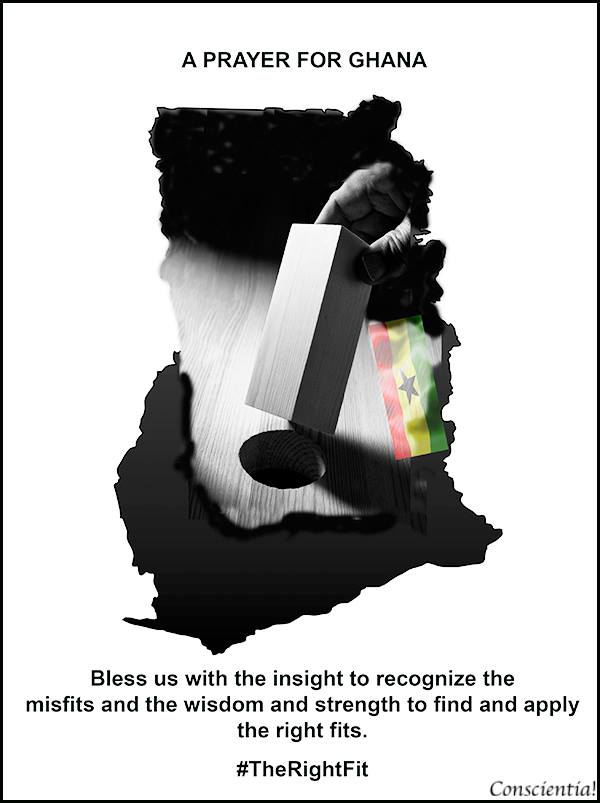
Don’t Intimidate! Don’t Threaten!

“The freedom to criticize judges and other public officials is necessary to a vibrant democracy. The problem comes when healthy criticism is replaced with more destructive intimidation and sanctions.”
– Sandra Day O’Connor
Words Matter
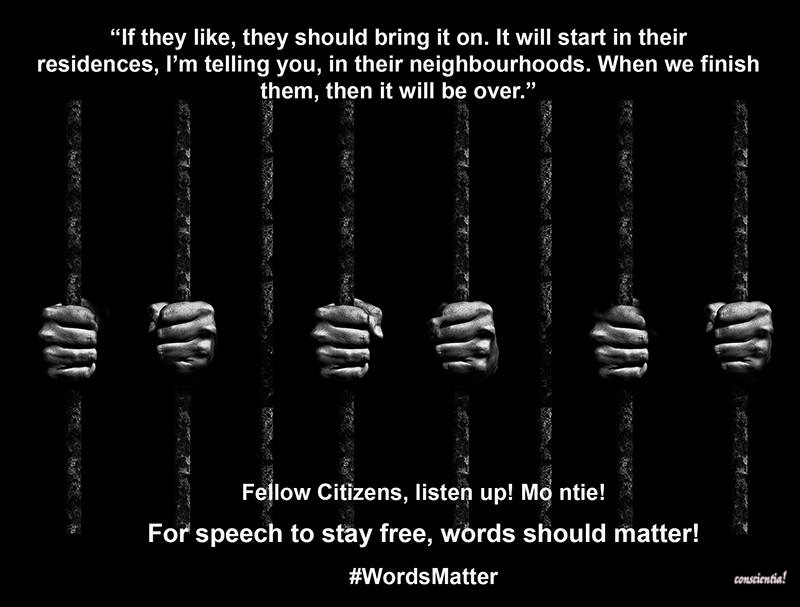
Words…they matter!
Sure, maybe you did not intend to carry out the threat but how was the threatened supposed to know? Maybe you only intended to disrupt the lives of those you threatened through the fear your words induced. Maybe not. Maybe you were just mouthing off!
However, to the threatened, that was intimidation and in the context of what happened in 1982, that was living in terror!
We all value Freedom of Speech but for speech to stay free, words should matter!
#WordsMatter
#TheConscientiaCampaign
End Misogyny!
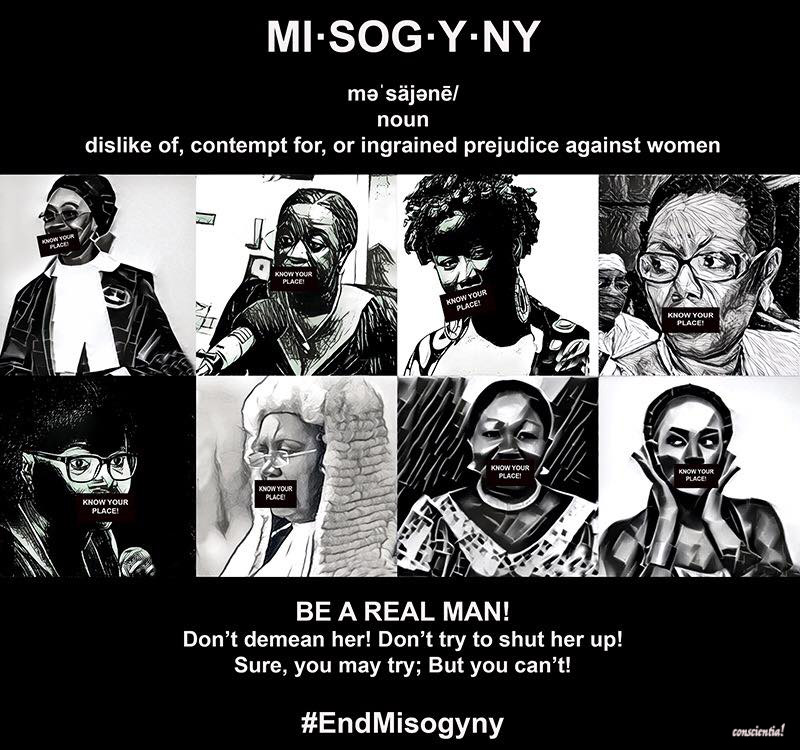
#EndMisogyny
#StandWithThem
#TheConscientiaCampaign
“And since we all came from a woman
Got our name from a woman and our game from a woman
I wonder why we take from our women
…….do we hate our women?
I think it’s time to kill for our women
Time to heal our women, be real to our women!”
– from “Keep Your Head Up” by Tupac
The Rant
“Don’t judge a man until you’ve walked a mile in his shoes”.
– an Old saying of controversial origin.
Somewhere in Middle America….
What the heck is going on here?
I can hardly recognize this place anymore! Everywhere I go, I hear and see strange people! Where did they come from? Walk down Main Street. Half the stores have names I cannot even pronounce.
Thirty years ago, we were 85% of the population. Now we are only 60%! Let that sink in – 60%. At this rate, we will be an endangered species in 50 years!
They are coming from everywhere, taking our jobs here and shipping the rest out. Look at our towns – deserted landscapes of boarded-up homes and factories!
Together with those bleeding hearts, they even made one of them President and he wasn’t even born here. Consider that! Even worse, I hear he worships differently! And he is President!
He wants to take our money and our guns. He wants to weaken us so he can rule forever.
Now they march around openly claiming they matter more than we do. The nerve! The absolute nerve!
Even scarier are those who want to kill us off, change how we worship and replace our laws. I say, stop them all from coming in. We need some law and order now!
We built this country with our sweat and blood. We fought for it. Our ideas made it what it is. It is ours. We want it back! We need to take it back! We used to be the greatest. Now, we are but a shadow of who we are. I say, we need that greatness back now!
I sit and listen to all theses clowns wanting to be president and wonder if any of them sees things the ways I do and has the guts to say what needs to be said!
I wonder, I really do…
Thoughts from the 2016 DNC
I’ve long been guided by this saying by George Bernard Shaw:
“I learned long ago, never to wrestle with a pig. You get dirty, and besides, the pig likes it.”
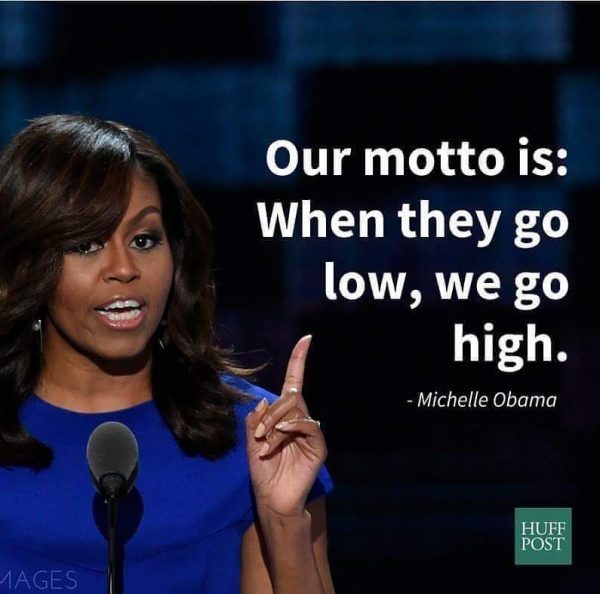
I guess the Obamas believe in the same thong and that’s why the FLOTUS said:
“…How we explain that when someone is cruel or acts like a bully, you don’t stoop to their level. No, our motto is, when they go low, we go high.”
I’ve always sought to reconcile how this country was founded and the ideals she was founded on. Monday night, Sen Cory Booker of NJ said these words that got me thinking:
“But our founding documents weren’t genius because they were perfect. They were saddled with the imperfections and even the bigotry of the past…
But those facts and ugly parts of our history don’t distract from our nation’s greatness. In fact, I believe we are an even greater nation, not because we started perfect, but because every generation has successfully labored to make us a more perfect union.”
The US is a great nation not only for what she has been, what she is now but the potential she still holds. Change and progress have come in fits and starts but come they have. I look at how divided the nation is now and wonder if it is a fit or a start. I hear the vitriol and rancor and wonder if we can really get it right this time!
History is an interesting thing. If it is not revised, it is a great tool….
After Michelle Obama’s speech on Monday, there was a claim by Bill O’Reilly of Fox that the slaves who worked on the White House were “well-fed”.
Well, there is actually a first hand account that disputes this claim and is from no other than Abigail Adams, the wife of the John Adams, the 2nd President of the US. She moved into the WH while it was still under construction. David Graham has a piece in the Atlantic about this so I pulled up the reference, which is a letter Abigail Adams wrote. It can be found in the National Archives.
“In the letter to her uncle, a Dr Cotton Tufts, she writes:
From Abigail Smith Adams to Cotton Tufts,
28 November 1800
Columbia City of Washington Novbr 28 1800
Dear Sir
…. The effects of Slavery are visible every where; and I have amused myself from day to day in looking at the labour of 12 negroes from my window, who are employd with four small Horse Carts to remove some dirt in front of the house. the four carts are all loaded at the same time, and whilst four carry this rubish about half a mile, the remaining eight rest upon their Shovels, Two of our hardy N England men would do as much work in a day as the whole 12, but it is true Republicanism that drive the Slaves half fed, and destitute of clothing…whilst the owner waches about Idle, tho his one Slave is all the property he can boast, Such is the case of many of the inhabitants of this place…”
I guess they were not that well-fed after all!
In all, I thought the black man who had more reason to be cynical and dark rather exuded more brightness and hope than the billionaire who exuded darkness and cynicism a week ago in Cleveland. Question is, who will the people listen to?