That Grace Thing

“By the Grace of God!” is probably the most beloved Ghanaian expression. That Grace is what supposedly allows all the good that happens in a Ghanaian life to happen.
My friend, the writer, and publisher Nana Awere Damoah put it best when he wrote, “The best health insurance policy in Ghana is the Grace of God”.
 
Are we Ghanaians the only recipients of this Grace?
I doubt it because aren’t we all humans supposed to be God’s creation?
If so that Grace is showered on all and makes good things happen everywhere!
Look around!
Some countries and people apparently are getting a lot of this Grace. Some have so much of this Grace of God, they even lend us some!
 
Is this God that unjust and unfair that he distributed this Grace in such an inequitable manner?
I doubt it!
Maybe this so-called Grace does not exist!
Or maybe you get what you demand of this Grace.
Maybe you get what you ask for, demand for work for, even beg for, borrow for…
Maybe you even get what you steal!
Ask the men and women who are living in opulence in Accra from money they stole from the coffers of the country how they are doing today and I bet you $100 the answer will be, “Nyame adom oooo!” (By the Grace of God!).
 
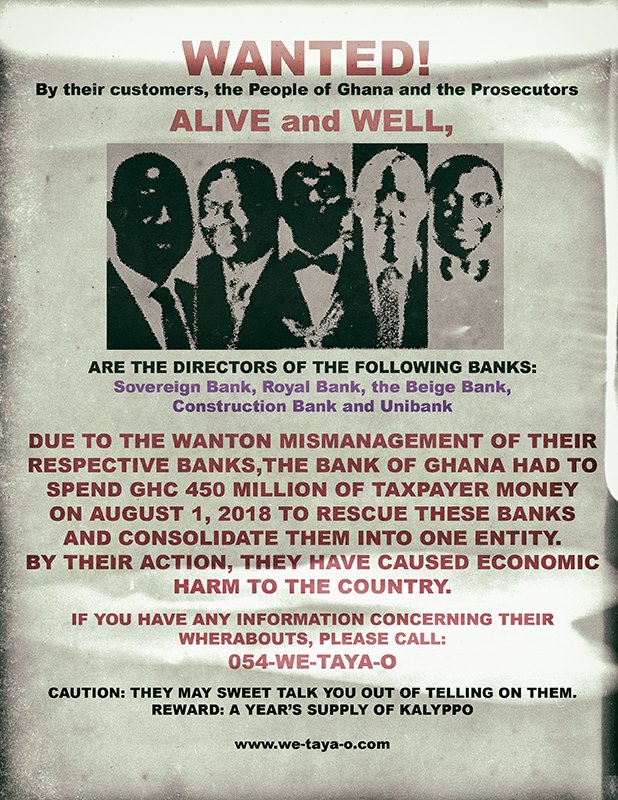
Ghanaians woke up yesterday to the news that the Bank of Ghana (BoG) was creating the Consolidated Bank Gh. Ltd to take over five struggling banks in the country – Sovereign Bank, Royal Bank, The Beige Bank, Construction Bank and Unibank. The five banks had run into liquidity challenges. I guess when the owners of those banks made it a practice to steal from their own banks and customers, they made those banks illiquid. When those who were supposed to watch these institutions went to sleep on the job, these banks were destined to fail.
Interestingly, at those times when these owners were flush with the cash they had stolen from their banks and customers, if one had asked them how they were doing, they would have answered with a smile, “By God’s Grace”.
As the Bank of Ghana spends taxpayer money to bail out these banks thus depriving the common Ghanaian of things like ambulances and schools, ask the Ghanaian how he is doing and he will reply, “By God’s Grace”. The same Grace that allowed these bankers to steal is also making Ghanaians apparently docile and accepting of such financial crimes.
 
Some grace!
 
The poor and destitute live by the “Fa ma Nyame” (Give it all to God) ideology and hope for an eternal life that comes after this miserable interlude. An interlude that they’ve been made to believe does not matter and whose misery they accept, happy with the droplets of that Grace that fall on them occasionally.
The powerful, the politicians and bankers also chant the “Fa Ma Nyame” mantra and claim they believe in a better life after this one but they go a step further. They make sure this life is NOT miserable. If they have to steal from the coffers of the nation to do that, they do. If in stealing they leave a lot of Ghanaians poor, destitute, hungry, uneducated, without healthcare, drinking water and power, it matters not. It is all “by the Grace of God!’
 
In 1555, the preacher John Bradford saw a criminal walking to the gallows somewhere in England and uttered these words:
“There but for the Grace of God goes John Bradford”.
Maybe when the powerful who steal from Ghanaians see the suffering masses that is what they say to themselves in the comfort of their air-conditioned V8s.
Maybe these powerful men, these politicians, and greedy bankers need to realize what happened to John Bradford – he was burned at the stake months later. That Grace failed him! Or did the Grace summon him to that eternal life?
 
Whatever the case is, I hope the people of Ghana will realize that one gets the amount of Grace one demands…or steals!…and demand their fair share of this Grace!

Those potential 181,993 “Kubɔlɔrs”

The free Senior High School (SHS) policy of this NPP government has unmasked several poignant problems and disturbing facts.
The most disturbing probably is that 181,993 kids would have probably not gained entry to a SHS! Let that sink in!
If this policy fails, we go back to producing over 180,000 “kubɔlɔrs” a year!…and every Ghanaian knows who a “kubɔlɔrs” is! (a truant, a dropout, a ne’er-do-well)
Remember the saying, “If you think education is expensive, try ignorance”.
 
With a predominant boarding school system – 60% of the SHS are boarding schools – 90,000 of these 1st year SHS students have no spot for a secondary education. This has forced the government to consider a policy that I hope will be a short-term fix – a two-semester multitrack system.
We’ll come back to that system later but before that, let’s look at some numbers and impress upon ourselves why a predominant boarding schools system may be the bottleneck in implementing a viable free SHS program.
 
Per the government’s own numbers, if it was to expand facilities to meet the added needs of the 181,993 children, an amount of GHC 1.3 billion would be needed for 622 six-unit classroom blocks,181,993 student desks, 3,730 teachers’ furniture, 415 dormitories, 51,868 bunk beds, and 8,872 new teachers.
Whereas the 622 six-unit classroom blocks are estimated to cost GHC 404 million, the 415 dormitories will cost GHC 539 million and the 51,868 bunk beds an additional GHC 41.4 million!
Even the 8,872 new teachers will cost GHC 267 million, close to GHC 200 million less than the dormitories!
 
Let these numbers sink in. Take your time.
 
Am I wrong then to argue that a predominant boarding secondary school system is not the right model for our struggling educational system and porous budget?
There are those who insist that the boarding system has produced outstanding Ghanaians over the years and so we should keep the system. Well, in the process we have also managed to leave close to 200,00 kids behind every year!
The total for dormitories and bunk beds is almost GHC 600 million! That will build over 300 more six-unit classroom blocks or countless libraries or after school centers or buy school buses or hire more teachers or build labs for STEM education.
 
Now the multitrack system is definitely cheaper. It is expected to cost about GHC 323 million to fully implement. I do not have the breakdown of costs but I bet it is weighed down by boarding expenses and as a nation, we really need to cut the dependence on this boarding system.
 
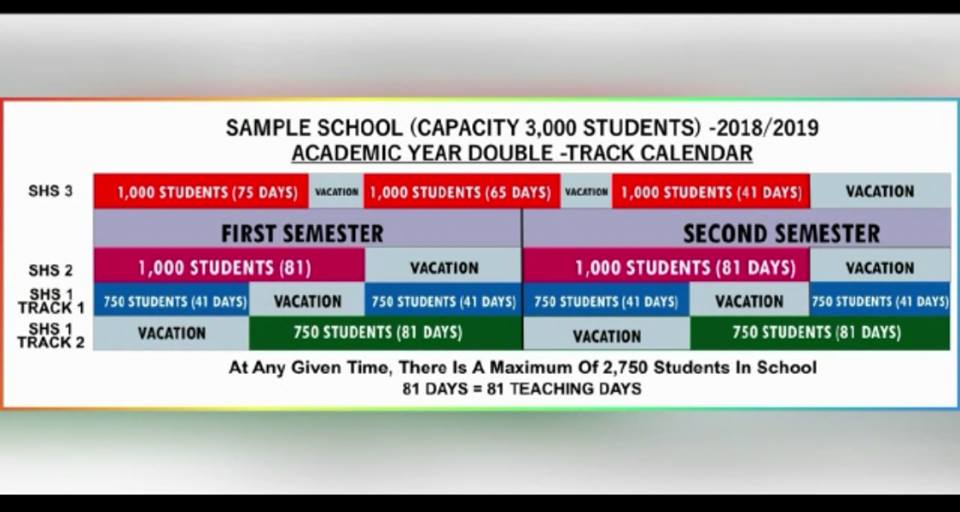
The attached image illustrates how the multitrack system will work:
My question is whether the 81 days where the kids are at school includes or excludes weekends.
If they exclude weekends, the 81 days of school translates to about 16 weeks of tuition. That also means the kids are home for 8 weeks between the 1st and 2nd semesters and 12 weeks before the new school year starts.
Even though they will have more hours of tuition while at school, it does seem like the school kids will be home a lot!
If the days include weekends, that is even worse!
Maybe thought should be given to organizing camps for these kids while at home. This should not only be the job of the government but also of the society at large – churches, our universities, civic organizations, youth groups – they could all get involved.
The kids could be taught coding, computer skills, carpentry, masonry, sports etc. Things that will not only feed the mind but the body too. These activities could serve as the beginning of the establishment of day schools and help us wean ourselves off a system that worked but is now just not feasible.
 
If we really want to avoid creating over 180,000 “kubɔlɔrs” a year, then we have to accept the fact that a predominant boarding school system at the secondary level has outlived its affordability and it is high time we changed things!
That Enchanted Tree

I tell you, there is something in there!
From its perch by the road, it pulled me closer,
Mesmerizing me with its twists, turns, and dips.
It exuded a story in the circles of its age,
In the sinews of its twines.
It was a portal to another place,
A hidden valley of mysteries and secrets.
It stood there, beckoning…

“That Enchanted Tree”

The Day Model is Possible

The US has about 98,000 public schools serving some 50 million kids from pre-K to 12th grade. None of them have boarding facilities. Education is free. The average cost is about $11,600 per student per year.
There are just over 33,000 private schools serving some 5 million kids. Only 300 of them are boarding schools, charging anywhere from $15 – $65k a year.
In 2016, the percentage of high school students enrolling colleges was at about 69%. The graduation rate for public schools was about 85% and that for the private sector was around 98%.
 
With the right preparations, a predominant and cheaper day model of secondary schooling can be realized.
 
NOTE: I did not ask to abolish boarding schools but rather to make the day schools the predominant model of secondary schooling.
 
With that said, let’s look at 10 ways we could make that happen:
 
1. Every Ghanaian needs to be on board that free education at the primary and secondary levels should be free. Illiteracy is killing us.
 
2. Every kid from any Ghanaian family should be eligible for free education. This makes all invested in the program. A tax should be levied to pay for the program. It is well worth it and all efforts should be made to get all earning adults to pay this tax, even those in the secondary economy.
 
3. Each child shall be due a set amount of money per year for schooling. That money totally covers tuition, books, transport to and from school for a total distance of 40 km a day and two meals in a day school model. If the child goes to a boarding facility, the extra cost is borne by the parents.
 
4. Return all the old missions schools back to the missions that use to run them. Those churches can opt to keep them as boarding schools or make them day facilities. Also, allow private secondary schools and some boarding schools.
 
5. Divide each region into school districts. Each district gets a school, school buses and an after-school center that also houses a library.
One district, one day SHS
One district, one afterschool center
One district, one school bus
 
6. Kids go to school and return home strictly with the bus or are dropped off by their parents or a responsible adult.
 
7. Small villages and towns can be clustered together into a district and be served by one school. Several buses can transport students to and from school. Alternatively, a boarding school could serve the needs of such communities.
 
8. It is 2018. Education should go to the kids NOT the kids to education. Distance learning can supplement the kids’ education.
 
9. For kids at the risk of distractions due to child labor, consideration should be given to sending them to boarding facilities.
 
10. To those who say we cannot afford this, remember the famous saying, “If you think education is expensive, try ignorance”. We have been trying ignorance for a while and I think we all can agree that it is pretty expensive.

Ten (10) Reasons why Ghanaian Secondary Schools should be Predominantly Day Schools and NOT Boarding Schools

1. The boarding school system is significantly more expensive. It is estimated that it costs about $114 per child per term in the boarding system but only $16 in the day setting.
 
2. The boarding schools are overfilled and their resources stretched, making them rife for outbreaks of diseases and pests like bedbugs and lice.
 
3. Kids with learning disabilities like Dyslexia and behavioral problems like ADHD, get lost among the hundreds of other kids. They do not receive the personalized care they need and go through the system without any benefits.
 
4. Teenagers, at a very important part of their development, grow up with very minimal input from their parents on issues of character, responsibility, independence, and morals. They learn more from their peers than from responsible adults. These kids need more time with their parents at those impressionable ages.
 
5. At a time when kids are actively growing, they have to live in boarding houses where nutrition is suboptimal stunting growth. Long periods of frank starvation may play a role in the future incidence of diabetes.
 
6. The healthcare afforded to these kids is not always the best and there have been instances of sick children dying due to negligence.
 
7. The negative psychological impact on these kids has never been measured but the separation does lead to anxiety, depression and psychological trauma in some wards. These conditions can have long-lasting negative sequelae.
 
8. Stories of abuse and bullying of all types are underreported but could be rampant and have long-term pathologic effects.
 
9. There is the incidence of drug and alcohol use that could have long-term effects.
 
10. It is quite difficult for parents to actively monitor the education their wards are receiving and many are unable to intervene if need be.