
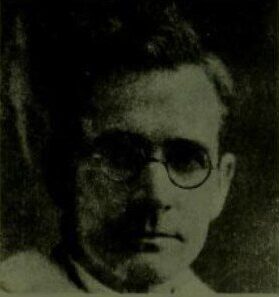
“Who hurts the honor of the School hurts my honor. It is the only thing I have in this country.”
– Rev. R.A. Lockhart, 1927
The Mfantsipim School campus has 2 main parts: the buildings on the top of the hill form “the Academic Site”, and those at the bottom of the hill, as you enter the school from Kotokuraba, form “the Domestic Site”. The academic site buildings were the first ones to be erected on the present campus. Construction started in 1929, and the boys moved into them in January 1931.
The story of the construction of those buildings is one of a headmaster who loved the school like no other and fought for it at all times. It is also the story of a long and intense brouhaha between this headmaster – Rev. Lockhart – on one side, and the Office of the Governor of the Gold Coast and the first Principal of Achimota School, Rev Fraser, on the other. It was a beef even the Methodist Church could not mediate, and one that drew in all the newspapers in Cape Coast at the time. Lastly, it is the story of a school that made so much out of the little it had, and the local communities that believed in it.
So how did it all start?
Mfantsipim in the 1920s was on Mount Hope. By 1924, the campus had become too small for the 68 students, and the waiting list stretched for 2 years. There was no way to expand the campus. The two previous headmasters, Rev Sneath and Dyer, had thought of moving the campus to Kwabotwe Hill, but they could not raise the funds.
Enter Rev. R.A.Lockhart.
He arrived in the Gold Coast in 1922 as the assistant to the then headmaster, Rev Dyer. He became the headmaster in 1925. In those three years, he witnessed the space problem at the school. He was also in the Gold Coast as the economy boomed from cocoa and gold exports. He witnessed the projects the then-governor, Guggisberg, embarked on in his “Ten-Year Development Plan”. One of these projects, conceived in 1924, was the plan to build the Achimota complex of schools, which was to consist of a kindergarten, elementary, and secondary schools, and a training college for teachers. It was going to have a hospital, playing fields, a farm, and a model village with a research facility, an arts and handicrafts block, a gym, a swimming pool, and a printing press, all that sitting on an area of 550 hectares or 1359 acres. Total budgeted cost was a whopping £640,000.
Construction began in 1924, and by 1929, all the schools were up and occupied. The Prince Of Wales himself was there for the laying of the foundation in 1925 and Guggisberg opened it in 1927. The schools were maintained with a budget of £68,000 a year.
Rev Lockhart was also at Mfantsipim when Governor Guggisberg and the future head of Achimota, Rev. Fraser, visited in 1924, and were all praises for the School. He was there when Kwegyir Aggrey visited several times and lauded the work being done.
So when Lockhart planned to build a new campus for Mfantsipim on the 80 acres of Kwabotwe, consisting of 4 classroom-dormitory blocks, 4 housemaster quarters, an admin block, a science block with 4 labs,a dispensary, and 2 bungalows, he hoped the colonial government would help out with 50% of the £40,000 budget. He hoped to build in two phases.
He planned to raise the rest from school fees, appeals to all farmers, market women, traders, chiefs, and workers in all the Fante towns and villages, and from the Methodist Church.
He had the land donated to the school by Jacob Wilson Sey and hired an architect to draw up a plan for the campus for £150. So in 1925, he set up a building committee to help with fundraising and help manage the construction.
Assuming the government would help, he initially focused on raising funds from the Fante communities. And the committee hit every Fante town you can think of – from Cape Coast to Asikuma; from Winneba to Anomabo. The Methodist Church in the UK would also only help if he could raise £5,000, so he worked hard to raise this. By March 1929, he had raised just over £9000 pounds and reached out to the colonial government. He was told there was no money and to reapply. Truth be told, there was a worldwide recession by then. That September, construction started at the site, and Lockhart reapplied in October 1929 and was told he would only get a third of the £20,000 he had hoped for, so £6800. In January 1930, when the Colonial governor, Slater, laid the foundation stone, he repeated the promise to provide a third of the £20,000. However, by November 1931, the government had given Mfantsipim only £3,300 pounds. When Lockhart requested the remaining funds, he was told that if he wanted more money, he needed to turn Mfantsipim into an elementary school.
That is when the brouhaha started.
In his address on Speech-day in 1931, he did not mince his words and blasted the government for going back on its promise, for asking Mfantsipim to become an elementary school, and for cutting teachers’ assistance by 55%. The newspapers piled in, asking how Achimota could be assisted with £1450 per student, while Mfantsipim, a secondary school with all the history and results, received only £45 per student. The Colonial Office never addressed the issue of funding but insisted that Lockhart got the 55% drawdown of the assistance for the teachers wrong. The fight drew in Rev. Fraser, who tried to defend Achimota’s funding. The head of the Methodist Mission in Ghana, Rev. Webster, tried to mediate but to no avail.
Without the help, Lockhart had to take a loan of £5000 from the Church in the UK. He also received a soft loan of £3000 from Mr. Pickard, a great friend of the school, and from the Church’s offertories and fundraising programs in the Gold Coast. By the beginning of 1933, the government had contributed a total of only £3960 out of a total of £22,349 raised. So the project took a little longer to finish than he had planned. The fourth dormitory was built in 1935, the great assembly hall in 1936, and the science block was not built until after independence, when Nkrumah’s government funded it.
The issue of funding pissed Lockhart off so much that he pulled Mfantsipim out of the annual Empire Day celebrations, starting in 1927 and continued till 1935, to lambast the colonial government.
Surprisingly, in February 1936, he announced he was leaving his position as the headmaster and returning to the UK. Many believe the colonial government forced the Methodist Church to oust him.
One can only wonder why the colonial government was so reticent to support the school. One can argue that the times were economically hard, and that even the construction of the gym, swimming pool, and chapel at Achimota was halted. Their stipend was also reduced to £48,000 a year. However, the demand to turn Mfantsipim into an elementary school as a prerequisite for more funds just reeks of an ulterior motive.
In spite of these humble beginnings, Mfantsipim dominated the Cambridge Certificate Exams throughout that period, and by the time Lockhart left, it was the most famous secondary school not only in the Gold Coast but in the whole of West Africa.
We also see in the story how Fantes from all over contributed in their small way to help build this campus. It showed how much they valued education and believed in the school.
Lastly, the story shows how indebted the school is to Lockhart. Not only did he move us to Kwabotwe Hill despite all the odds, but he also believed in the dream of Mfantsipim and fought for it every single day.
References:
Bartels, F. L. The Roots of Ghana Methodism. C.U.P. in Association with Methodist Book Depot Ltd, 1965.
Boahen, A. Adu. Mfantsipim and the Making of Ghana: A Centenary History, 1876-1976. Sankofa Educational Publishers, 1996.