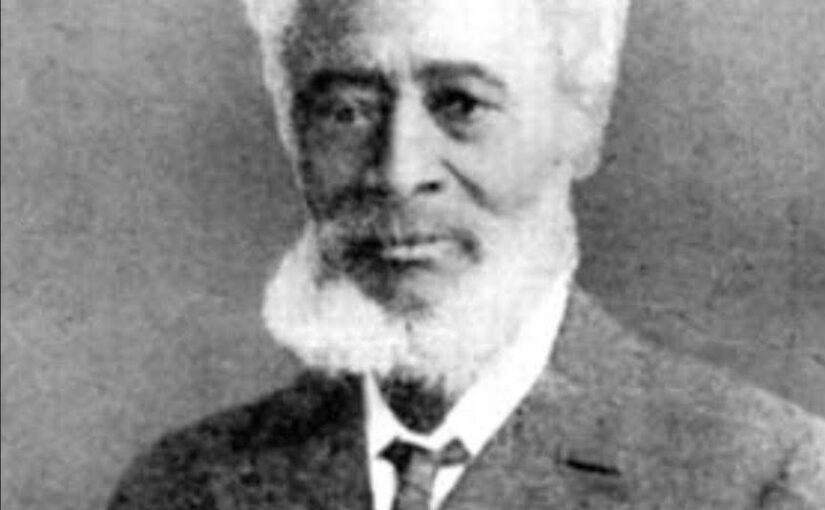
Of all the unsung heroes and unknown founders of Mfantsipim School, W.E. Sam may be one of the most impressive.
The type of person he was is probably shown by his funeral on July 18, 1906, in Cape Coast. The Gold Coast Leader reports that his burial at Fahudzi Cemetery was a large, imposing event attended by many and escorted by police under the supervision of Superintendent Webb.
William Edward Sam came from an Akyem family but ended up a Cape Coast man. He was born on March 9, 1833. He became an early convert to the Christian faith and served for some years as a teacher in the 1840s under Rev. Thomas Birch Freeman, the Father of Ghana Methodism and the “Freeman” in “Freeman-Aggrey”. He taught at a school Birch Freeman opened in Beulah, a settlement he established 8 miles from Cape Coast.
By the 1860s, Sam had quit teaching and was working as an agent for a number of African and European merchants on the Gold Coast, including F&A Swanzy (which would eventually become Unilever).
Besides being a great businessman, he was also an excellent negotiator and mediator. Hence, the British hired him to be a mediator between them, the Dutch, and the coastal chiefs. He also fought alongside the British against the Asantes, as most Fantes at that time did.
After the 6th Asante War, he was made chief magistrate and commandant for the fort at Axim. From this position, he made many trips into the gold-bearing areas around the Ankobra. He struck up relationships with the Wassa chiefs that would prove very significant for his career down the line.
All this time, he kept working for F&A Swanzy. In 1878, he accompanied a partner of the firm named Crocker on a gold-prospecting mission through the Wassa areas. He secured what became known as the Wassa (Gold Coast) Mine at Adja Bippo.
He had two sons – William Edward Sam Jr. and Thomas Birch Freeman Sam (T.B.F.). They both went to England after their secondary education to train as mining engineers at the Crystal Palace School of Practical Engineering. They joined their dad in the mining operations for F&A Swanzy, but also opened and operated several mines privately. In 1899, Sam lost his son, William Edward Jr., in a mining accident, and for the rest of his life, he worked closely with T.B.F. in the mining business. The latter would become the dominant mining engineer in the Wassa areas for years and published on the ore types in the area and on gold mining.
Sam would come to be known as “Tarkwa Sam” and the “Mining King of West Africa”.
Like most wealthy business people in Cape Coast at the time, he was politically and socially active. He was an active member of the Aborigines Rights Protection Society and became its president in 1902. Never having forgotten his beginnings as a pupil teacher, he became a great advocate for education in the Gold Coast, a philanthropist, and a very generous benefactor of Mfantsipim School.
When Rev. Kemp closed the school in January 1889, Sam was one of the men who contributed money towards its reopening.
After the Fante Nationalists finished fighting the Lands Bill of 1897, Mensah Sarbah turned his attention to education for the Fantes. With Sam’s support, he managed to convince chiefs in the gold-mining areas to donate 10% of the annual concessions they received from miners to a fund named the “Mfantse National Educational Fund” in 1902. Two of the trustees of the fund were Sam and J.E.Casely-Hayford, and T.F.E Jones was the secretary and treasurer. The plan was to open schools and offer scholarships in the former Fante Confederacy. The fund opened primary schools at Prestea and Himan.
Realizing that remittances from the chiefs would not be enough to establish enough schools, Mensah Sarbah and Sam decided to raise money through public subscription. They decided to form a publicly traded company that would sell shares to raise money. Since every new company in the Gold Coast had to be registered in London (Mensah Sarbah later got that law changed), Sam and Mensah Sarbah found themselves heading to London on the “SS Tarkwa” in November of 1903. It was on this trip that the two men hatched the idea of founding a secondary school with proceeds from the public offering to the company they were about to open – a company they planned on naming “the Fante Public School Ltd”. “The object of the Company was to establish, conduct, and maintain in the Gold Coast and other parts of Africa any Schools, colleges, universities, educational academies, institutes, seminaries, polytechnics, educational and other training institutions…” (GCL, March 12, 1904).
The company hoped to raise £7500 by selling 15,000 shares at 10 shillings per share (note: 20 shillings make £1).
On their return, they sold the idea to the other Fante nationalists of the ARPS, who bought into it. The directors of the new company were W.E. Sam, J.E. Biney, and Chief R.A. Harrison. J.P. Brown was an ex officio member, Mensah Sarbah the solicitor, and D.M. Abadoo the secretary.
On April 5 1905, the Fante Public Schools Ltd opened its first secondary school named “Mfantsipim”. Their first location at Coussey’s House, a location donated by W.E.Sam. He also donated the room where the company’s Board met.
W.E Sam, besides being one of the two originators of the idea of forming the Fanti Public Schools Ltd to open Mfantsipim School, also became one of the school’s biggest financial backers (Adu Boahen, 1996). He, together with Biney and Harrison, acquired a total of 2300 shares in addition to what they already had, to allow the opening of Mfantsipim. So the true total amount of money Sam contributed to the school’s founding is significant and not fully appreciated. He continued to support the school after it opened and even after its amalgamation with the Collegiate School.
Moreover, in his will, Sam bequeathed £700 to the Mfantsi National Education Fund. This money was used, after his death, to establish a scholarship fund for six boys at Mfantsipim School, which ran for a few years in the early 1900s.
And yet Mfantsipim has not honored this amazing philanthropist and founder in any lasting way, shape, or form. His name is on no buildings, and nothing is named after him. Like a piece in the Gold Coast Leader of August 4, 1906, stated:
“If ever any should be ‘monumented’, Sam should be, but we have no public building in which to place his effigy to be gazed upon by sojourners to come. We have no squares in which either in bronze or stone to erect a statue, an obelisk, or a fountain to commemorate his name and so recall his good works, let us then rename one of our Towns or found a new town and name it ‘Sam-ville’.”
William Edward Sam is a true founder and hero of Mfantsipim School.
References:
– Bartels: History of Ghanaian Methodism, 1965
– Adu Boahen: Mfantsipim and the Making of Ghana, 1996
– Hutchinson: Pen-Pictures of Modern African Celebrities, 1929
– Gold Coast Leader of August 4, 1906
– Gold Coast Leader of July 21, 1906
– Dumett: El Dorado in West Africa, 1998
– Kimble: A political history of Ghana: the rise of Gold Coast nationalism, 1850–1928, 1963