
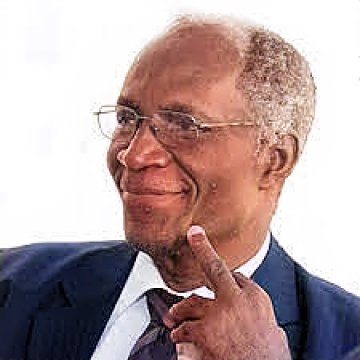
Of all the sons of Kwabotwe I have written about so far, the significant contributions of the late Prof Daniel Afedzi Akyeampong to the field of Mathematics are achievements my puny brain cannot grasp.
A Google search lists them as follows:
– Applications of higher symmetry groups (1966; his doctoral thesis),
– SU(3) transformations (1972),
– Charged vector meson theory (1965), and
– Tensor harmonics (1979).
Born in 1938 in Senya Beraku in the then Gold Coast, he entered Mfantsipim in 1954 and was in Balmer-Acquaah House. Even then, his intellect dazzled.
After Botwe, he went to Legon, graduating in 1963 with a BSc in Mathematics.
He left for the UK in 1963 to do his PhD in Mathematics. Before he started on his doctoral work, he had to get a foundational diploma in mathematical Physics at Imperial College. He brilliance must have been very noticeable because after completing the coursework in Group Theory in 1964, the professor who taught the course called him to his office and made him an offer.
This professor was Abdus Salaam, a Pakistani theoretical physicist who would go on to win the 1979 Nobel Prize in Physics for his contributions to the electroweak unification theory.
Back in 1964, Prof Salaam was starting a new international center for theoretical physics in Trieste, Italy. He invited the young Daniel Akyeampong to join him as one of the first five fellows of the Institute that is now known as “the Abdus Salam International Center for Theoretical Physics (ICTP)”.
Those years in Italy saw him publishing high-quality papers like “The scalar behavior of charged vector meson theory at high energy (1965)”, and “The quark model and elastic baryon-baryon scattering (1967)”.
In 1966, he got his PhD in Mathematical Physics from the University of London. His thesis was titled “Applications of higher symmetry groups to particle physics”. He also got a Diploma in Mathematical Physics from Imperial College.
Now, the aim of Salaam in establishing the ICTP was to foster the growth of the physical and mathematical sciences in developing countries. In that, Daniel Akyeampong was a firm believer. In 1966, he returned to Ghana as one of the first two Ghanaians to obtain a PhD in Mathematics (the other being Francis Allotey).
Back at home, he became a pioneer of Ghanaian Mathematics. Moreover, he turned out to be a great academic leader. He became a full professor of Mathematics at the age of 44. He would also serve multiple terms as the Head of the Department of Mathematics and as the Pro-Vice Chancellor of the University of Ghana.
He not only championed mathematics in Ghana but also on the African continent. He served as an assistant editor of the journal, “Afrika Matematica”. He was on the editorial board of a journal of the African Academy of Sciences, “Discovery and Innovation”.
He also lectured at the ICTP in Italy and was a member of the World Academy of Sciences.
The onus of his work was probably expressed best in the J.B. Danquah Memorial Lecture he gave in 1993. Titled “The Two Cultures Revisited: Interactions of Science and Culture”. Building on the lecture given by the British novelist and scientist C.P. Snow in 1959, Prof Akyeampong “advocated for integrating African indigenous knowledge and cultural values into scientific processes to bridge the historical divide between science and culture.”
Prof Akyeampong passed on March 7, 2015, following complications after surgery for a femur fracture, leaving behind a legacy of pioneering in Mathematics in Ghana and academic leadership.
Professor Daniel Afedzi Akyeampong was an illustrious son of Mfantsipim, a Botwe boy.