
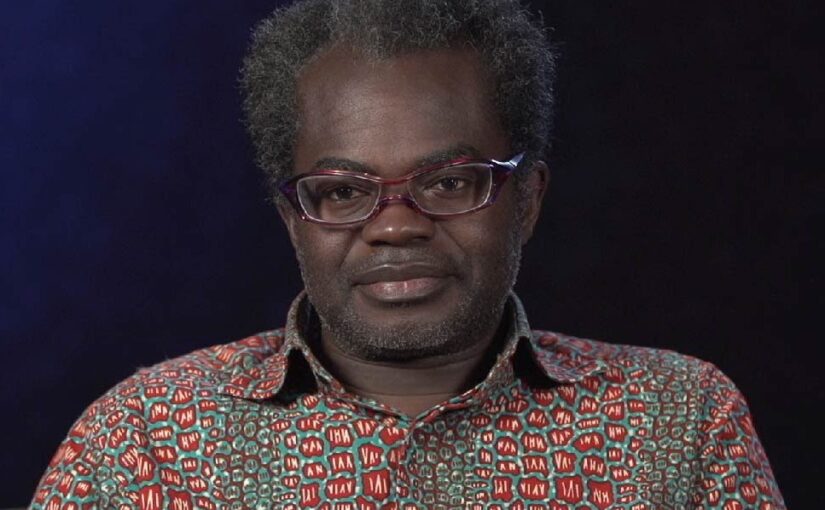
The son of Mfantsipim I present in this piece works in a field that is not easy to understand. I did not trust myself to do justice to his efforts but hoped to do my best, so here we go.
Kwabena Boahen was born on Sept 22, 1964. Affectionately called “Buster,” a nickname he got from a nanny, he was the second child of the late great historian Prof Albert Adu Boahen. He entered Mfantsipim in 1976, so he was a “centenary greenhorn”.
Ever the tinkerer, he invented a corn planting machine while in Form 3, together with a classmate, Michael Banson. The machine would win the National Science Fair and be later presented at the West African one in Lagos.
At age 16, he got his first personal computer – a BBC Micro. After reading about how it was put together and worked, he took it apart and was not awed by its simplicity. That experience might have planted the seed for his life’s direction – an elegant and more efficient way of computing.
At age 21, he won a scholarship to study Electrical Engineering at Johns Hopkins. During his time there, he heard a lecture by the computational neuroscientist, Terry Sejnowski. It was about using a neural network to turn text into speech. That experience lit a bulb. There could be a more elegant way to build computers!
Around that time, a computer scientist named Carver Meade at Caltech was working on building computer chips that were structured like neurons in the human brain. He believed that the most efficient computers should combine both analog and digital processing like the brain. The new field would come to be known as “Neuromorphic Computing.”
Not too long after hearing Sejnowski’s speech, Kwabena’s TA challenged him and a classmate to replicate the work Carver Meade was doing at Caltech. The work they did resulted in two successful papers, and brought him to Carver Meade’s attention.
After finishing his bachelor’s and master’s at Johns Hopkins, he worked for a year and then started his PhD at Caltech under Carver Meade in 1990, graduating in 1997. His interest in building chips based on the brain’s architecture meant he had to do some neurobiology coursework. The organ he picked for his research was the retina of the eye. His thesis would be the creation of a silicon retina.
After completing his PhD, he moved to the University of Pennsylvania, where he was the first occupant of the Skirkanich Term Junior Chair. He was there until 2005. He published further work on the silicon retina and a silicon tectum, several papers, gave many talks, and even graced the cover of Scientific America.
In 2005, he moved to Stanford, where he founded the Brains in Silicon Lab. His aim was to create a team that would work towards linking “neuronal biophysics to cognitive behavior through computational modeling”. He sought to “emulate the brain with silicon chips through neuromorphic engineering.” In that regard, he has been quite successful.
His team has created the “Neurogrid.” This is an iPad-size platform that emulates the cerebral cortex of the brain. It was built using neuromorphic chips, which allow it to be a supercomputer. In 2022, he and a colleague, Philip Wong, created a dendrite-like structure using chips. Kwabena has also published even more papers.
So, what are the advantages of neuromorphic chips? Structured like the neurons of the brain, they are more efficient. As Kwabena says, “the brain computes analogically and communicates digitally.” This, among other things, allows it to use much less energy than computers. So, using neuromorphic chips, AI processes will not need as many chips and as much energy.
If Carver Meade is the father of neuromorphic computing, Kwabena may be the preeminent disciple. His output and awards are impressive. I counted 144 papers on Google Scholar. His honors include a Packard Fellowship for Science and Engineering (1999) and a National Institutes of Health Director’s Pioneer Award (2006). He was elected a fellow of the American Institute for Medical and Biological Engineering (2016) and of the Institute of Electrical and Electronic Engineers (2016) in recognition of his lab’s work on “Neurogrid.”
Presently, Kwabena Boahen, aka Buster, is a Professor of Bioengineering and Electrical Engineering at Stanford University, with a courtesy appointment in Computer Science. He is also an investigator in the Bio-X Institute, the System X Alliance, and the Wu Tsai Neurosciences Institute. Further, he founded and runs the Brains in Silicon Lab at Stanford.
Kwabena is an illustrious son of Mfantsipim, a Botwe boy.