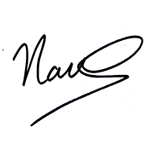
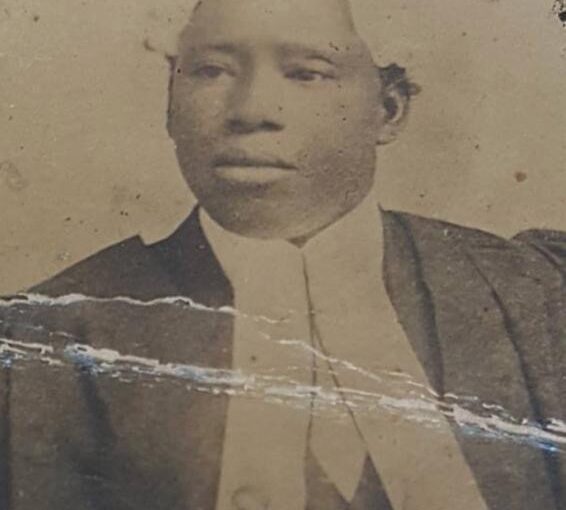
In the two books that delve into the history of Mfantsipim – Bartel’s “The Roots of Ghana Methodism” or Adu-Boahen’s“Mfantsipim and the Making of Ghana: A Centenary History, 1876-1976” – he is not mentioned as part of the first group of students admitted to Wesleyan High School (Mfantsipim’s precursor) in April of 1876. However, many indicators point to the fact that Samuel Emmanuel Kaye, who was born in Cape Coast in 1862 and died in 1903, is not only an Old Boy but also part of the founding class.
While going through newspapers from that era for research into an unrelated topic, the writer came upon the obituary for a man named “Samuel Emmanuel Kaye” who died in January 1862 in the Jan 24, 1903 edition of the Gold Coast Leader (GCL). In the piece, he was described as being “one of the first pupils of the Wesleyan High School under Mr. (now Rev.) James Picot”!
Since James Picot was at school from April 1876 till Feb 1878, Kaye was either part of the foundation class or entered a year after that class.
In another piece from the Dec 24-31,1921 edition of the same paper about the Rev. Attoh-Ahuma, another Old Boy, is this paragraph:
“Attoh-Ahuma did not join the Sarbahs, the Kayes, the Egyir-Asaams, and the Mark Hayfords during the principalship of Mr. James Picot, one of the finest educationalists the country has ever known…Attoh-Ahuma appears to have joined the school at the time of Principal Jenkins when Sarbah and others were in the highest form.”
So it seems Kaye was in the same class with John Mensah Sarbah and Egyir-Assam, two students noted to be in the founding class by both Bartels and Adu-Boahen.
(However, the mention of Mark Hayford as part of that class throws up another name that has not been cited as a foundation student by either Adu-Boahen or Bartels. Mark Hayford is the younger brother of Ernest James Hayford, who was sent with Kofi Asaam to be trained as teachers in Freetown in 1873 in preparation for the opening of the Wesleyan High School. The two returned in 1877 and joined the school as student-teachers. It is possible that, like Ernest’s younger brother started with the Mensah Sarbah and others in 1876.)
After graduating, Kaye worked in the colonial government in Elmina and Accra till 1895, when he left to study law in England. He returned in 1898 and practiced till he passed away at the age of 40 on January 16, 1903, in Cape Coast. His death was described as a “national loss”.
He had a sister called Sophia Kaye, and to commiserate with her and the family and pay their respects, a group of Ghanaian students who were studying law in England when Kaye died in Cape Coast sent her a wreath. Shipped in February from England, its arrival in Cape Coast was reported in the Gold Coast Leader from August 22, 1903.
These students were E. J. P. Brown, J. E. Biney Jr., J. P. Brown-Pope, H. F. Ribeiro, O. K. Quarde, W. W. Brew, and John Theo Halm. Per the report in the paper, they described Kaye as “one who endeared himself to his people and was held in great esteem and respect by all”.
In Adu-Boahen’s book, “Mfantsipim and the Making of Ghana: A Centenary History, 1876-1976,” he notes that Samuel Kaye is one of the men who bought shares to help reopen the Wesleyan High School after it was closed by Rev. Kemp in 1889.
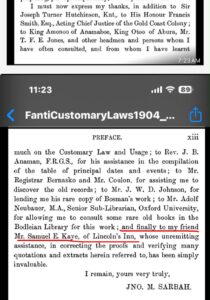
In the last paragraph of the preface of John Mensah Sarbah’s 1904 book titled “Fanti Customary Laws”, he writes:
“…and finally to my friend Mr. Samuel E. Kaye, of Lincoln’s Inn, whose unremitting assistance, in correcting the proofs and verifying many quotations and extracts herein referred to, has been simply invaluable.”
Samuel Kaye’s father was Nana Kwesi Kyei of Denkyira who ruled from 1859 to 1869 and brought Denkyira into the ill-fated Fante Confederacy in 1868. His mother was a Safohene from Cape Coast called Nana Akua Awer. (The name “Kaye” is the anglicized version of “Kyei,”).
The chiefs of the Fante Confederacy, as a group, helped instigate a high school. It would only make sense that the son of one of them would attend the first one opened in Cape Coast by the Methodist Missionaries.
Kaye had three children – Elizabeth, Ekow (who is an Old Boy), and Charlotte. Elizabeth married Mr. Josiah, and together they had two daughters – Beatrice and Esther. Esther married Emmanuel Brew-Butler, whose uncle was William Ward Brew – one of the students who sent Kaye’s sister Sophia a wreath when he died in 1903.
William Ward Brew, an Old Boy, became a great lawyer, Vice-President of the ARPS and co-founder of NCBWA. After leaving Wesleyan High School (Mfantsipim) in 1894, he worked as a clerk and then taught at both the Collegiate School and Wesley Girls before heading to England to study law in 1902. He was called to the bar in 1905. He practiced in Calabar, Nigeria for a while and was the first black judge there. Back in Ghana in 1917, besides his law practice and other civic duties, he headed the Building Committee as Rev. Lockhart built the first structures on Kwabotwe Hill in the late 1920s, and he was legal counsel for Mfantsipim until he died in 1943. Ward Brew also donated the land that Wesley Girls stands on today.
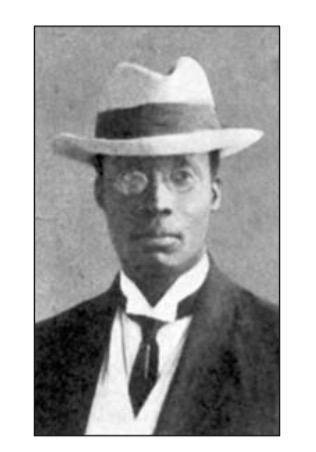
Emmanuel Brew-Butler was a manager at UAC and the founding father of Ebusua Dwarfs. With Esther, they had eight children six daughters and two sons.
One of the sons, Nana Sam Kaye Brew-Butler, was named after his maternal great-grandfather and also inherited the Safohene stool that his great-great-grandmother occupied decades ago. A business executive, he is the former Chairman of the Ghana Football Association, Chairman of the University of Cape Coast Council, Founder, Chairman and Shareholder of Cenpower Holdings, and Shareholder and Director of Arab Contractors Ghana. He followed in the footsteps of his great-grandfather to Mfantsipim and is a member of MOBA 1969.
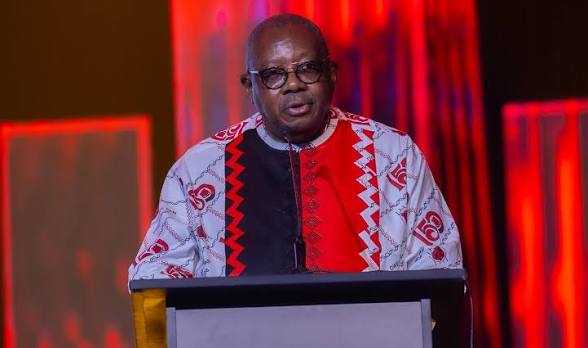
Interestingly, at the launch of the 150th anniversary celebrations, Nana Sam Kaye Brew-Butler was picked to be the Distinguished Speaker. Unbeknownst then to all involved, not only did they pick an illustrious and very accomplished son of Mfantsipim, but they also picked the great-grandson of a member of that great founding class of 1876 – the great-grandson of Samuel Emmanuel Kaye.
References:
1. Bartels, F. L. The Roots of Ghana Methodism. 1965.
2. Boahen, A. A. Mfantsipim and the Making of Ghana: A Centenary History, 1876-1976, 1996.
3. Hutchison, C.F. The Pen-Pictures of Modern Africans and African Celebrities, 1922
4. Gold Coast Leader Jan 24, 1903
5. Gold Coast Leader August 22, 1903
6. Gold Coast Leader Dec 24-31,1921
7. List of rulers of the Akan state of Denkyira. Wikipedia
8. Family accounts from the Brew-Butler Family