
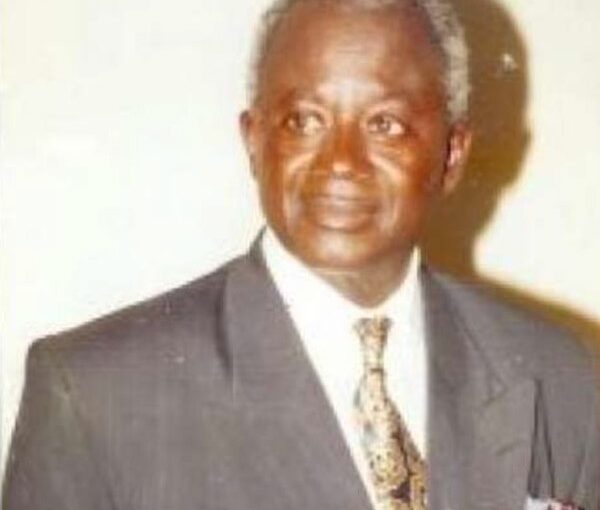
The late Albert Kwadwo Adu Boahen was born on May 24, 1932 in Oseim in then Gold Coast. He entered Mfantsipim in 1947, graduating in 1950. He would later study history at the University of Ghana, where he got his BA, and then at the University of London, where he got his PhD in African history in 1959.
An illustrious career in teaching and scholarship would follow. Besides becoming a professor emeritus in history at the University of Ghana, a department he headed for many years, he was also a visiting professor at several universities around the world. He also had a publishing career that spanned over 40 years with books that became authoritative texts on African history like:
– Topics in West African History (1966),
– African Perspectives on Colonialism (1987),
– Mfantsipim and the Making of Ghana : A Centenary History, 1876–1976 (1996), and
– Yaa Asantewaa and the Asante–British War of 1900–1 (2003).
He was president and consultant of the UNESCO committee that the published of the multi-volume “General History of Africa” between 1983 and 1999.
As impressive as his scholarship was his political activism that was built on courage and fearlessness. Even as a student at Mfantsipim, he participated in a students’ protest in 1948 against the detention of the “Big Six”. In the 1970s, he fought against Kutu Acheampong’s UNIGOV.
This courage would shine brightest in 1987-88, during Rawlings and the PNDC’s reign of terror. At a time when no one dared to criticize Rawlings, he did. At a time when critics just vanished, fled the country or were jailed, he spoke up.
The events that led to the professor speaking out started with a column by Rawlings. After 6 years of brutalities, Rawlings suddenly noticed that there were no critics anymore, and Ghanaians seemed apathetic. In the Daily Graphic of April 6, 1987, the then ‘Chairman Rawlings’ lamented a ‘Culture of Silence’ that he saw pervading the country. He wrote that “.. people at various levels of authority are using the chain of command to subjugate and demand a subservient state of interrelationships with subordinates….. that this situation was leading to the return of the ‘Culture of Silence’….. between high government officials and the public, District Secretaries and the people; chiefs and their subjects; bishops, priests and church members; managers and workers.”
No one responded then. How could they? Everyone was terrified. However, one man soon found his voice. About a year later, Professor Adu Boahen, spoke up. The dear professor gave three lectures as part of the Danquah Memorial Lectures organized by the Ghana Academy of Arts and Sciences at the British Council in February, 1988. His lectures were titled “The Ghanaian Sphinx: Reflections on the Contemporary History of Ghana, 1972 – 1987”.
During one of those lectures he had this to say to the then Chairman Rawlings:
“I am afraid that I do not agree with Rawlings’ explanation of the sedulity of Ghanaians. We have not protested or staged riots because we cannot but because we fear the PNDC. We are afraid of being defamed, liquidated or dragged before the CVC or NIC or being subjected to all kinds of molestations. And in this case have Ghanaians not been protesting at all as the Head of State thinks? They have been but in a very subtle and great way – hence the Culture of Silence.”
He would go on to be the flag bearer for the NPP in the 1992 elections. He unfortunately lost to Rawlings’ NDC. He would lose the NPP flagbearer position to Kuffour for the subsequent elections 1996 and 2000 but stayed active in the party.
On the evening of his 74th birthday, May 24, 2006, he died at the 37 Military Hospital after suffering strokes in 2001 and 2002.
Albert Kwadwo Adu Boahen is an illustrious and courageous son of Mfantsipim, a Botwe boy.