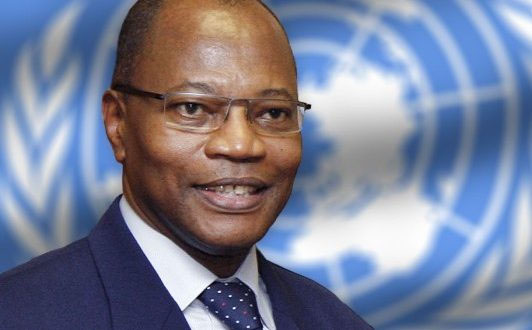
Dr. Mohamed Ibn Chambas is a Ghanaian lawyer, diplomat, politician, and academic. He is a respected peace and security mediator and has been involved in mediating conflicts in Liberia, Côte d’Ivoire, and Sudan.
He has not only served his country as a public servant, starting as a Member of Parliament and Deputy Minister, but has also been active on the international scene, leading ECOWAS and the ACP, and working for the UN and the AU.
At the moment, he serves as the African Union High Representative for Silencing the Guns. He also chairs the mediation efforts of the Quintet, a group made up of the African Union (AU), the Intergovernmental Authority on Development (IGAD), the League of Arab States, the European Union (EU), and the United Nations (UN) to bring peace to Sudan.
Before all these great achievements, Dr. Chambas attended Mfantsipim School, where the foundations of his illustrious career were laid.
Mohamed Ibn Chambas was born on Dec 7th, 1950, in Bimbilla in the Northern Region of Ghana. Most of the schools in the North at that time were local authority (L.A.) schools and a good number of teachers were not from the North. Mohamed thus attended an L.A. primary school in Bimbilla where the headteacher, a Presbyterian from Santrokofi in the Oti Region, changed his first name from “Mohamed” to “David”. It would be years later at the University of Ghana in Legon before he would change it back to “Mohamed”.
The story of how he entered Mfantsipim in 1963 – a school that was 578 km away school and at the time had only one other student from the North, and maybe 10 of the Muslim faith – shows the brilliance and promise that young Mohamed exuded even at that age. It also showed his ability to face and take on challenges with courage, a trait that would be made more evident with his later career as a mediator.
Back then, one took the Common Entrance Exam to get into a secondary school. Students in Forms 2 – 4 in middle school were allowed to take the exam. The exam was administered by the West African Examinations Council (WAEC). It consisted of four subject papers written in a single day: English Composition, English Comprehension/Grammar, Mathematics, and General Paper. The exam was graded out of a maximum of 400 marks, and to get into the top schools of the day, like Mfantsipim, Wesley Girls, St. Augustines, Adisadel, and Achimota, one needed a score above 290, preferably 300.
On registering for the Common Entrance, students had to pick three secondary schools they wanted their scores sent to. These schools were ranked in order of preference, with the 1st choice being the most preferred. Excellent students would pick the top schools of the day as the first choice.
Mohamed took the Common Entrance exam in 1963 when he was in Form 2 at the Bimbilla L.A. Middle School. On the day the students in Forms 2 – 4 at the school were filling out the registration forms for the exam, the headteacher, Mr. Daniel K. Puni, went from class to class listing all the top Schools on the left side of the blackboard in each classroom. He advised the students not to pick any of those schools as their chances of getting in were slim. On the right, he listed the schools they had higher chances of getting accepted to.
When he got to Mohamed’s Form 2 class, after writing out the lists, he walked over to the desk where Mohamed sat and said, “But you should select Mfantsipim as your first choice school”.
Mohamed stared at him, totally surprised. Mr. Puni assured him he would get in, and so Mohamed picked Mfantsipim as his first choice. What made it even more remarkable was that the headteacher, Mr. Puni, a Catholic, was an Old Student of St. Augustine’s College.
A few months after the exams, he got a letter of invitation to the Mfantsipim interview. Back then, student interviews were part of the admission process.
Mfantsipim held the interviews for the southern sector of the country at the school in Cape Coast and for the northern sector in Kumasi. He had his interview with the headmaster, Rev. Brandful, in August 1963.
He was accepted and entered Mfantsipim in September 1963, where he would earn the nickname “Chambo”. He was in Schweitzer House, which was later merged with Lockhart House to form what is now Lockhart-Schweitzer.
About his time in Mfantsipim, he said it instilled a lot of self-confidence in him. However, one was also constantly reminded by the headmaster and the staff that it is not where you are but what you do with the opportunities there, and so one always had to think and look ahead. And he did. His life epitomized that.
Dr. Mohamed Ibn Chambas is an illustrious son of Mfantsipim School, a Botwe boy and an active member of MOBA 1968.