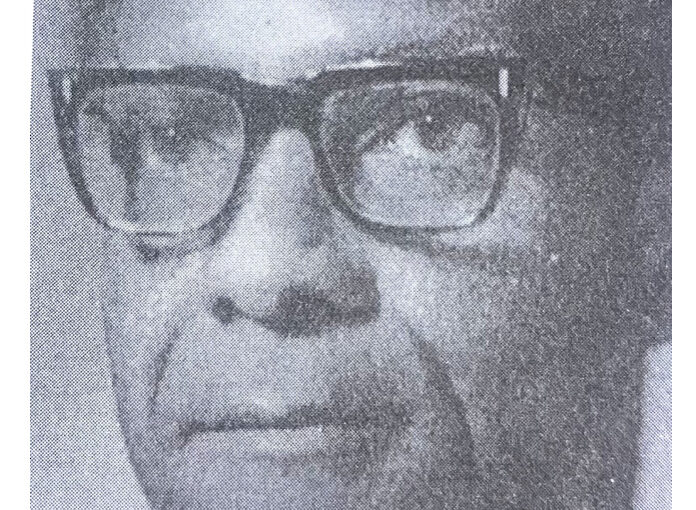
In 2006, June Milne, historian and editorial assistant to the late President Kwame Nkrumah, published a biography titled “Kwame Nkrumah, a Biography.” On pages 207-208, she describes his routine in Conakry, Guinea, and notes that he would occasionally play chess in the afternoons with a member of his entourage called “Leonard Blay.”
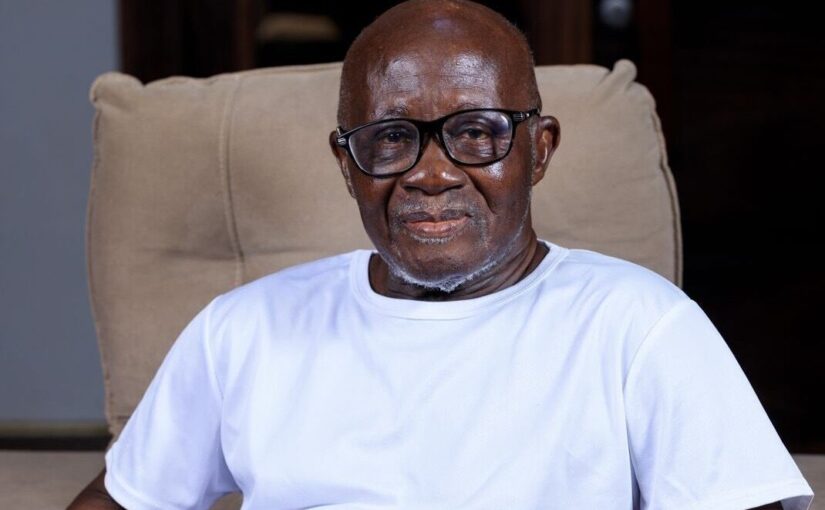
Moses Leonard Blay, the man she refers to, is an Old Boy of Mfantsipim School who has led an interesting life and, at an advanced age (he is now in his mid-80s), still remembers his experiences in great detail.
Moses, who hailed from Sekondi, entered Mfantsipim in 1957 and finished 6th Form in 1963. A brilliant science student, he was also the House Prefect of Lockhart House during his 6th-form years.
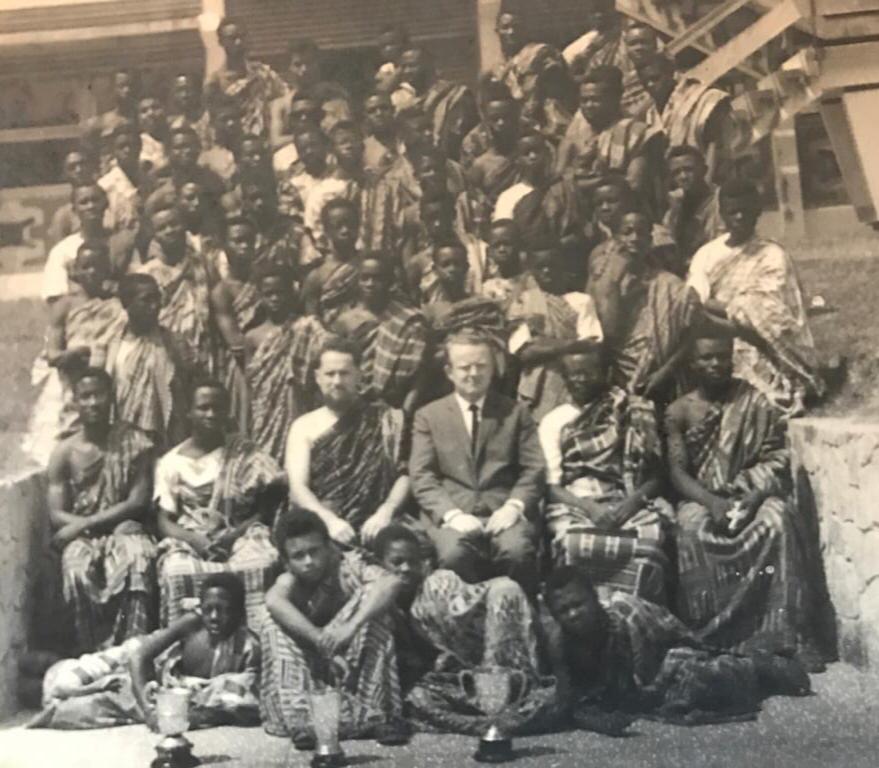
For the “A” Levels, his subjects were Maths, Applied Maths, and Physics, so most thought he would go into engineering or a science-related path. Instead, his life took a very different turn.
In 1963, after several assassination attempts on President Kwame Nkrumah, plans were underway to strengthen national security. Ambrose Yankey, a close assistant to the president, was tasked with creating a “Special Intelligence Unit” to protect him. To recruit staff for the unit, he reached out to the young Moses, whom he knew to be a brilliant student.
Moses found a career as an intelligence officer stationed at Flagstaff House interesting, and after 6th form, he headed to Moscow in the then-USSR for training. He went with Ambrose Yankey Jnr, Ambrose Yankey’s son, and Boye Moses.
They returned to Accra in 1964 and were stationed at Flagstaff House as part of the Presidential Detail. They collected and analyzed intelligence on presidential and state security and traveled with the president, scouting and securing places he was scheduled to visit.
Nkrumah believed African voices should be heard on global issues, so he sought a solution to the Vietnam War, which President Lyndon Johnson had escalated in 1965. A Commonwealth delegation to Hanoi got nowhere, but President Ho Chi Minh of North Vietnam then appealed to Nkrumah personally to mediate. However, due to intense American bombing, Ho Chi Minh could not assure Nkrumah of his safety if he visited Hanoi. In 1965, the US government of Lyndon Johnson assured Ghana’s Ministry of Foreign Affairs that the US would hold off the aerial bombing of Hanoi if and when Nkrumah visited.
So on February 21, 1966, Nkrumah left Accra for Hanoi, Vietnam, with planned stops in Egypt, Pakistan, India, and China.
Moses was on the team that went ahead to scout and prepare for Nkrumah’s arrival in China.
Nkrumah arrived in China on the afternoon of February 24. It was morning in Accra, Ghana, and a coup was underway to overthrow the government. Later that evening, the Chinese, who had gotten wind of the coup, informed Nkrumah of what had happened. Premier Zhou Enlai hosted Nkrumah and his entourage at the Diaoyutai State House until February 28, when he left for Conakry, Guinea.
In retrospect, it seems the Americans wanted Nkrumah out of the country so the coup they supported would succeed.
Nkrumah arrived in China with an entourage of close to 90 people. About half deserted him and returned to Ghana. He went to Guinea with a group of about 40-50 people, and Moses was one of them.
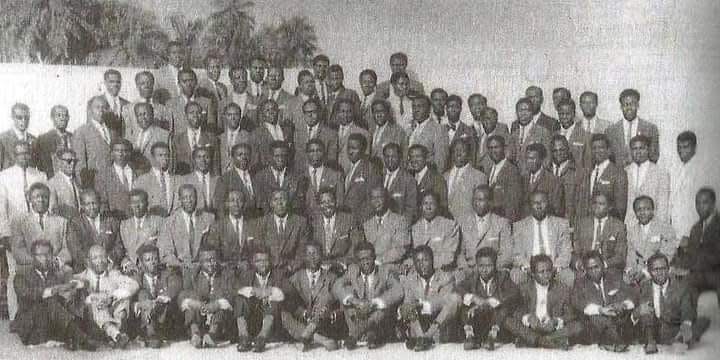
In Guinea, Nkrumah was declared Co-President by President Ahmed Sekou Toure, who put him up at the Villa Sylli in Cholea, a suburb of Conakry.
Sekou Toure and the people of Guinea held Nkrumah in high esteem. In 1958, France sought to cripple Guinea’s economy in response to its demand for independence by withdrawing all aid, equipment, and administrative personnel from the former colony. Nkrumah helped with a £10 million loan.
In Conakry, Nkrumah settled into a life that revolved around his writing and meetings with anti-colonial leaders and freedom fighters from not only across the African continent but also around the world.
Though Moses had been on Nkrumah’s detail since 1964 and had interacted with him before, Nkrumah did not know him personally. That changed when Nkrumah wanted someone to play chess with. Moses was the only one who could, and the chess ritual between them began.
Nkrumah also learned that Moses was the nephew of Lawyer R.S. Blay, one of the founders of the United Gold Coast Convention (UGCC), the group with which he began his political career in Ghana. Nkrumah had appointed him as one of the first board members of the Bank of Ghana in 1958, then as a Supreme Court Judge in 1962, and dismissed him in 1964. He also found out that Moses was Nzema, so the two could converse in their native language, far from home. Moses became not only Nkrumah’s chess-playing companion but also his personal secretary and speechwriter.
He thus sat in on conversations Nkrumah had with visitors such as June Milne, his research assistant and biographer, and Amilcar Cabral, the Bissau-Guinean and Cape Verdean anti-colonial leader.
It was a time when he had a front-row seat to history and the chance to interact with the former president and appreciate his qualities and beliefs.
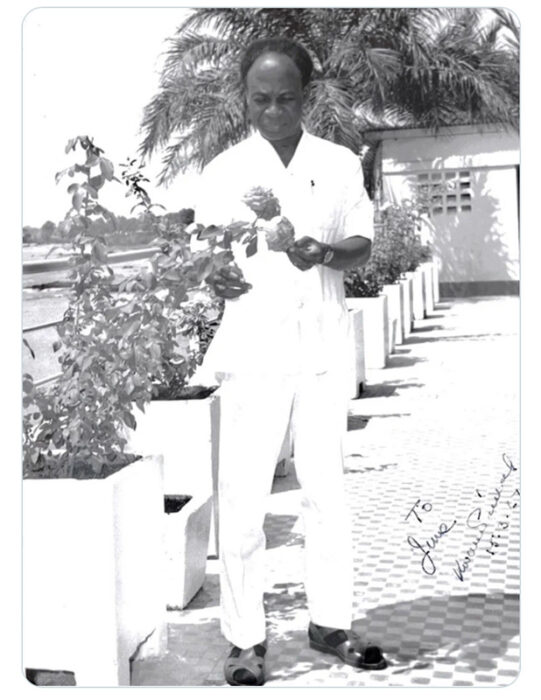
About 5 years after their arrival in Guinea, Nkrumah fell ill and was flown in late August 1971 to Bucharest, Romania, for treatment. Moses and most of the entourage stayed back in Guinea. After Nkrumah passed away on April 27, 1972, his body was flown back to Guinea, where Sekou Toure, who had refused Ghanaian requests to have the body repatriated directly from Romania, gave him a state burial in May in Conakry. Nkrumah’s widow, Fathia, and delegates from 40 countries attended. Among those present were Fidel Castro, William Tolbert, Siaka Stevens, Moktar Ould Daddah, and Amilcar Cabral. Moses was present during the funeral.
Then, in July 1972, after much negotiation, Sekou Toure agreed to send Nkrumah’s body back to Ghana. On July 17, the remains of the first president were returned aboard a Guinean Air Force plane, accompanied by the loyalists who had stayed with him in Conakry. Moses was one of them.
On arrival in Ghana, the contingent of 40+ men was detained at Peduase Lodge. They were interrogated by officers of the National Security Secretariat (SSS), who sought to determine whether they planned to subvert the ruling National Redemption Council led by Col. Acheampong. The latter had seized power from President Busia six months earlier.
During this time, Moses found that one of the army officers in charge of the detainees and an interrogator was a MOBA junior who remembered him. They helped make his detention somewhat bearable.
Four months after returning to Ghana, the Nkrumah loyalists were released from Peduase Lodge. Moses returned to his family in Sekondi. A year later, he entered the University of Ghana at Legon, where he studied Economics and Statistics. After graduation, he worked for USAID in the Ivory Coast until he was recruited by the Limann administration in 1979 to serve as Deputy Minister for National Security. After the Limann government was overthrown in 1981, he returned to the Ivory Coast, where he lived and worked until around 2000, when he returned to Ghana for good.
The year after Kuffour came to power, he was appointed Regional Security Coordinator for the Western Region. He held that position until his retirement.
Looking back, Moses would not change anything and appreciated all the lessons he learned. He worked closely with Kwame Nkrumah and describes him as a man who demanded honesty, loyalty, and excellence in all he did. He was principled and consistent.
He realized that Nkrumah believed Africans were capable of achieving anything, and argued that Pan-Africanism was the only way for Africans to control their lives and resources and prevent Western exploitation. Nkrumah was convinced that, after Africans had been made second-class citizens through centuries of exploitation, no price was too high to pay for Africa’s freedom, and that the unification of the continent was the way there.
He shared that, though some of Nkrumah’s positions sounded almost utopian, his dogged belief in the worth and abilities of the black man and in lifting up the African continent was very infectious and left a lasting impact on him.
Moses’ life epitomizes loyalty and the ability to stick to one’s convictions and to serve a cause, even to one’s detriment. He could have deserted Kwame Nkrumah and returned home to Ghana, but he did not. He stayed on till the very end.
Moses Leonard Blay, a son of Mfantsipim, has led an interesting life that deserves study and sharing.